THE SITUATION
Indian startups released FY25 financials (ending March 31, 2025) amid a recovering but selective funding market. The results reveal a stark bifurcation: “efficient growth” companies are rewarded with public market premiums, while “burn-heavy” models face valuation collapses or insolvency.
This isn’t just “mixed performance”—it is a structural decoupling. Zomato reported consolidated revenue growth of 172% while maintaining positive adjusted EBITDA, whereas Swiggy’s losses widened 33% despite revenue growth. Ixigo (Le Travenues) posted 128% profit growth in Q4 FY25, proving travel tech efficiency. Conversely, Byju’s effectively hit zero valuation amid insolvency proceedings, marking the definitive end of the 2021 excess era.
The impact: Capital is no longer blind. It flows exclusively to unit economics, not Total Addressable Market (TAM).
WHY IT MATTERS
For late-stage founders: Valuation multiples have decoupled based on profitability. Public markets now pay ~12x revenue for profitable leaders (Zomato) versus ~6x for loss-making challengers (Swiggy). For Series B+ investors: Governance creates a “trust tax.” Diligence timelines have doubled as investors scrutinize internal controls following the Byju’s collapse. For IPO aspirants: The “path to profitability” narrative is dead. Markets demand actual Profit After Tax (PAT) or definitive EBITDA positivity before listing.
BY THE NUMBERS
- Zomato Revenue: ₹13,968 Cr in Q2 FY26 (annualized rate), up 172% YoY (Source: Company Filings, Nov 2025)
- Zepto Revenue: ₹11,110 Cr in FY25, up 2.5x YoY from ₹4,454 Cr (Source: Regulatory Filings via Entrackr, July 2025)
- Swiggy Net Loss: ₹1,197 Cr in Q1 FY26, nearly doubled YoY from ₹611 Cr (Source: Company Filings, Oct 2025)
- Ixigo Profit Growth: PAT rose 128% YoY to ₹16.8 Cr in Q4 FY25 (Source: Company Filings, May 2025)
- Byju’s Valuation: Effectively $0, down from $22B peak (Source: Founder statements/Forbes, Oct 2024)
- Apple India Net Profit: ₹3,196 Cr in FY25, up 16% YoY (Source: Regulatory Filings, Nov 2025)
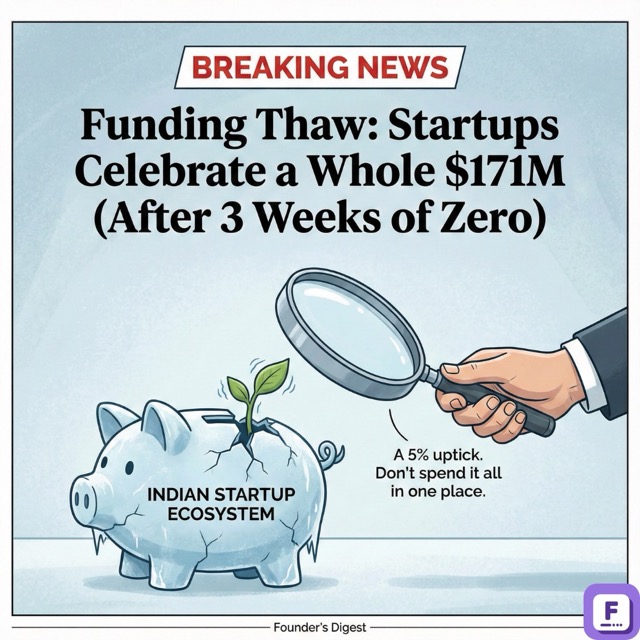
- Funding Trends: $171M raised in third week of Nov 2025, indicating a stabilized but low-volume flow (Source: Inc42, Nov 2025)
CHART CONTEXT
The Winner (Zomato): Zomato pivoted from restaurant discovery to delivery, then to quick commerce (Blinkit acquisition, 2022). Critical shift: Achieved profitability in FY24, validating the model. In FY25/26, Blinkit became the growth engine, with Net Order Value (NOV) growing 137% YoY. The strategy: Cross-subsidize quick commerce expansion with food delivery profits.
The Challenger (Zepto): Zepto forced the 10-minute delivery habit. Revenue exploded to ₹11,110 Cr in FY25, forcing incumbents to react. Unlike the 2021 era, Zepto improved unit economics, halving cash burn while growing 150%. Current status: Raising at ~$7B valuation, aiming for IPO in 2026.
The Cautionary Tale (Byju’s): Once valued at $22B, the edtech giant imploded in FY25 due to governance failures, delayed audits, and debt defaults ($1.2B term loan). Insolvency proceedings initiated in mid-2024. The collapse erased billions in shareholder value and triggered a sector-wide governance crackdown.
INDUSTRY LANDSCAPE
Quick Commerce (The New Battlefield): The sector is a three-horse race: Blinkit (Zomato), Instamart (Swiggy), and Zepto. Blinkit: Leads on efficiency. Adjusted EBITDA margin improved to -1.3% despite massive expansion. Instamart: Bleeding cash to catch up. Losses are high (₹797 Cr in Q1 FY26) due to heavy discounting and dark store expansion. Zepto: The aggressive third player. 29% market share, growing faster than rivals, but still burning cash to acquire users.
Travel Tech: Ixigo: Differentiates through low customer acquisition costs (CAC) via organic traffic from utility apps (train status). Financials: Revenue grew 72% in Q4 FY25 with a distinct profit focus, avoiding the heavy marketing burn of competitors like MakeMyTrip or EasyMyTrip.
Fintech: Consolidation is nearly complete. PhonePe and Google Pay dominate UPI volume. Paytm’s regulatory struggles in FY24/25 (RBI restrictions) ceded market share to competitors, proving that regulatory compliance is a survival metric in Indian fintech.
ANALYSIS
Current state: The Indian startup ecosystem has exited the “funding winter” and entered the “performance spring.” Capital availability is sufficient ($11.7B PE/VC investment in Q3 2025) but highly concentrated. The shift: Investors are bypassing “growth at any cost” models for “durable growth.”
Public sentiment reflects this discipline. On earnings calls, Zomato leadership emphasizes “adjusted EBITDA” and “sustainable margins,” a sharp pivot from the Gross Merchandise Value (GMV) obsession of 2021. Conversely, new listings like Mamaearth faced volatility when profitability metrics wavered, showing public markets have zero tolerance for earnings surprises.
Sector rotation is visible. Capital is moving out of generic B2C marketplaces and into:
- Quick Commerce Infrastructure: (Warehousing/Logistics)
- Deep Tech/Manufacturing: (EVs, SpaceTech, Semiconductors)
- Financial Services: (Lending/Wealth Management with proven yields)
FOR FOUNDERS
If you’re raising Series B+: Burn multiples > 2x are deal-killers. Audit your unit economics—if you lose money on a contribution margin 2 (CM2) basis, you cannot raise. Action: Cut marketing spend immediately to prove CM2 positivity before hitting the road.
If you’re preparing for IPO: Governance is now a valuation driver. The “Byju’s discount” applies to anyone with complex structures or delayed audits. Action: Appoint a Big 4 auditor 18 months pre-IPO. Clean up related-party transactions now.
If you’re in Quick Commerce/D2C: Competition is irrational. Action: Do not compete on deep discounting against Zomato/Zepto unless you have a proprietary supply chain. Pivot to high-margin private labels to survive the price wars.
FOR INVESTORS
For growth-stage portfolios: The valuation gap between “profitable” and “promising” is permanent. Action: Mark down assets that rely on future efficiencies to justify current burn. Push portfolio companies to sacrifice 20% growth for 50% burn reduction. Watch for: Competitors raising “down rounds” to consolidate—acquisitions will accelerate in FY26.
For new deployment: Look for “boring” efficiency. Ixigo’s success proves that low-CAC, utility-first models outperform high-burn, marketing-led models in the long run. Thesis: Buy companies that own their distribution (organic traffic) rather than rent it (Google/Meta ads).
THE COUNTERARGUMENT (Could be, would be, should be)
The strict focus on profitability stifles innovation and cedes the market to incumbents. If capital markets only fund EBITDA-positive companies, deep-pocketed players (Zomato, Reliance, Tata) will monopolize emerging sectors like Quick Commerce, as startups cannot afford the initial burn required to build infrastructure. India’s consumption story is still early—penetration of e-commerce is <10%. Premature profit-taking could result in under-investing in the generational infrastructure needed for the next decade. This would be correct if: (1) Consumer discretionary spending collapses in FY26, making efficiency irrelevant, or (2) A new wave of cheap capital (low interest rates) floods the market in 2026, rewarding risk-taking again.
BOTTOM LINE
The bifurcation in Indian startups is structural, not cyclical. Companies that solved the “profitability puzzle” in FY25 (Zomato, Ixigo) will compound their lead, while those dependent on external capital (Swiggy, Byju’s) face existential compression. Profit is no longer a feature; it is the product.
Would you like me to break down the specific unit economics of Blinkit vs. Zepto to see who wins the long-term cash flow war?
