THE SITUATION
Traditional search predictability is collapsing. Gartner predicts search engine volume will drop 25% by 2026 as users shift to AI chatbots and virtual agents.
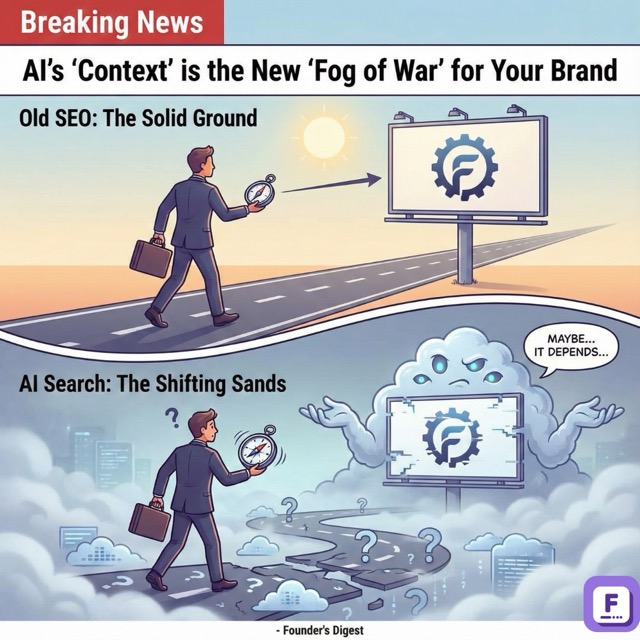
The core driver is the “Consistency Paradox”: unlike Google’s deterministic database (same query = same links), LLMs generate answers probabilistically based on context windows and temperature settings. A brand visible in one user’s session may vanish in another’s, even for identical queries.
This changes the fundamental unit of internet economics. We are moving from “retrieval” (ten blue links) to “synthesis” (one direct answer). Perplexity now processes 60-70 million queries daily, and OpenAI’s SearchGPT is retraining user behavior to expect answers, not lists.
WHY IT MATTERS
For CMOs: Customer Acquisition Cost (CAC) rises 30-50% as “free” organic traffic converts to “zero-click” AI answers where your brand is mentioned but not clicked.
For SEO Agencies: The retainer model breaks. You can no longer report “Rank #1” because rankings are now fluid, personalized, and unverifiable across different user sessions.
For Niche SaaS Brands: Visibility becomes binary. You are either the contextually perfect answer cited in the synthesis, or you are invisible. The “Long Tail” of search results (ranks 5-10) is effectively deleted.
BY THE NUMBERS
- Search Volume Decline: Gartner predicts a 25% drop in traditional search volume by 2026 due to AI agents (Source: Gartner, Feb 2024).
- Perplexity Scale: 30 million Monthly Active Users (MAU) as of early 2025, up 200% YoY (Source: Famewall/Perplexity internal data).
- Query Volume: Perplexity processes ~60-70 million queries per day (Source: Perplexity, 2025).
- Optimization Impact: Generative Engine Optimization (GEO) tactics (citations, quotes) can boost AI visibility by up to 40% (Source: Princeton University/Georgia Tech Study, 2024).
- Citation Source: 90% of ChatGPT citations come from search results ranking position 20+ in Google, proving top-ranking pages are not the only source for LLMs (Source: Semrush/Backlinko study, 2025).
- Perplexity Valuation: Jumped to ~$9B in late 2024, signaling massive capital betting on “Answer Engines” over “Search Engines” (Source: The Information/Perplexity, Dec 2024).
CONTEXT
The “Search” industry remained static from 1998 (Google launch) to 2022 with obvious advancement in search capability. It relied on a deterministic index: crawl the web, index keywords, rank links, etc.
OpenAI broke this in November 2022 with ChatGPT. By shifting from indexing to inference, they removed the need for the user to synthesize information. Perplexity (founded 2022) operationalized this by adding real-time citation layers, effectively creating a “citation engine” rather than a “search engine.”
The shift is structural: Google sells the path to the answer (ads + links); AI models sell the answer itself. This destroys the click-through rate (CTR) arbitrage that powered the commercial web for two decades.
INDUSTRY LANDSCAPE
The Incumbent: Google is forced to cannibalize its own ad revenue with “AI Overviews” (formerly SGE). They must answer queries directly to keep users, but doing so reduces the ad inventory they can sell.
The Challenger: Perplexity positions itself as the “Anti-Google”—no ads (initially), pure answers. With 30M MAU, they are the first viable threat to Google’s dominance since Bing (which failed to gain share). Their “Pro Search” creates a new behavior: deep research, not quick lookups.
The Wildcard: OpenAI (SearchGPT/ChatGPT) is not a search engine but a “reasoning engine” with web access. It captures the high-value, complex queries (coding, strategy, health) that previously drove high CPM ads on Google.
INDUSTRY ANALYSIS
The market is pivoting from SEO (Search Engine Optimization) to GEO (Generative Engine Optimization).
Current state: Brands are panicking as organic traffic dips. “Zero-click” searches are rising because the AI satisfies the intent without a visit.
The shift: “Keywords” matter less; “Entities” matter more. LLMs understand brands as entities with attributes (trust, pricing, reviews). If your brand isn’t established as an entity in the model’s training data (or RAG context), no amount of keyword stuffing will save you.
Public sentiment is shifting. Marketing leaders are openly discussing “Dark AI Traffic”—users who find a product via ChatGPT but arrive as “Direct” traffic in analytics because the referral header is stripped.
Capital flows confirm this: VC money is pouring into “AI Analytics” tools (like Gumshoe or proprietary agency tech) that attempt to measure “Share of Model” rather than “Share of Voice.”
FOR FOUNDERS
- If you rely on SEO for >40% of leads: Your funnel leaks within 12 months. Move budget from “content production” (blog posts) to “Digital PR” immediately. AI models cite authority, not frequency.
- If you are building a B2B Brand: Audit your “Entity Presence” by Q3 2025. Ask Perplexity/ChatGPT: “Who are the top competitors in [your space]?” If you aren’t listed, you don’t exist to the AI. Action: Update Wikipedia, Crunchbase, and ensure clear “About” schema on your site.
- If you have proprietary data: Publish it as “Knowledge Graphs” or structured data (JSON-LD). LLMs consume structured data 35% more effectively than prose. Make your data the easiest for the machine to read.
FOR INVESTORS
- For portfolios with heavy SEO dependency: Discount organic growth projections by 20% for 2025-2026. The “free lunch” of Google traffic is ending.
- For AdTech investments: Short legacy “Rank Trackers.” Their value prop is zero in a probabilistic world.
- For new investments: Look for “Share of Model” analytics platforms. Brands are flying blind regarding their AI visibility. The company that solves “How do I measure my visibility in ChatGPT?” builds the next $1B SaaS category.
- Watch for: Portfolio companies reporting “unexplained direct traffic increases.” This is the leading indicator of AI discovery.
THE COUNTERARGUMENT
The counterargument: Google is too entrenched and “Good Enough” search persists.
Google still commands 90%+ market share. The 25% drop predicted by Gartner might be overstated if AI models degrade due to “Model Collapse” (training on AI-generated junk). Furthermore, if AI search cannot be profitably monetized (ads in AI answers are clunky), the economic incentive forces a return to the “10 links” model.
This would be correct if: (1) Perplexity/ChatGPT user growth plateaus in 2025, or (2) Copyright lawsuits force AI companies to stop indexing news content, making their answers stale and useless compared to Google.
BOTTOM LINE
The “10 blue links” era is over. Visibility is now probabilistic, not deterministic.
Brands that optimize for keywords will disappear. Brands that optimize for entity authority—becoming the “unavoidable citation”—will capture the 40% of market share left behind by competitors still chasing Google rankings. The machine decides who wins now; teach it who you are.
