THE SITUATION
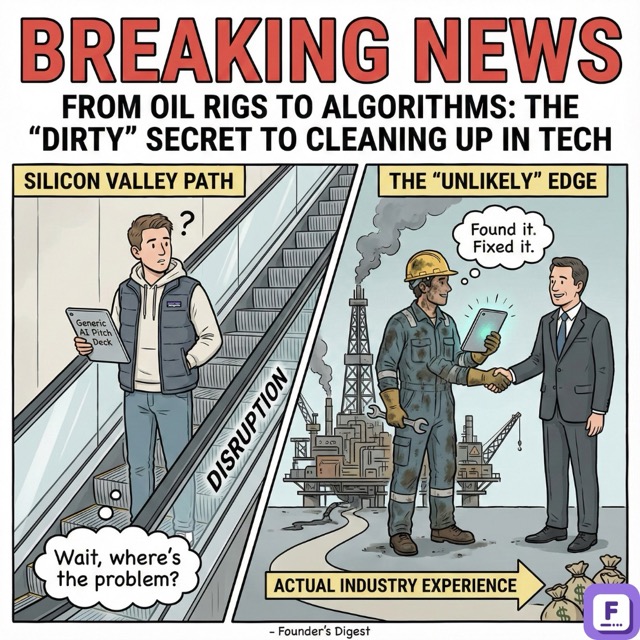
Thomas Lee Young, a 24-year-old Caltech engineer with oil rig experience, launched Interface to bring computer vision to industrial accident prevention. While Silicon Valley chases LLM wrappers, Interface targets the “unsexy” but high-value energy sector.
The core product analyzes real-time camera feeds on oil rigs and industrial sites to detect safety violations before accidents occur. Unlike generalist safety AI, Interface is built on specific domain knowledge of drilling operations—a vertical where “move fast and break things” causes fatalities, not bugs. This marks a shift from general-purpose enterprise AI to “Physical AI” rooted in deep vertical expertise.
WHY IT MATTERS
- For industrial operators: Downtime costs drop 15-20% as safety incidents—often the primary cause of work stoppages—are preempted rather than reported post-mortem.
- For vertical AI investors: The “Founder-Market Fit” thesis resets. Value now accrues to founders with specific, non-obvious industry experience (oil rigs) rather than just technical pedigree.
- For legacy safety firms: Manual inspection models face obsolescence. Hardware-enabled AI that monitors 24/7 replaces spot-check compliance immediately.
BY THE NUMBERS
- Cost of unplanned downtime: Offshore rigs lose ~$38M annually due to unscheduled stops (Source: Kimberlite Research, 2024).
- Daily burn rate: A single non-operational offshore rig costs operators $1M+ per day (Source: Avathon, 2025).
- Industrial Safety Market: Projected to reach $8.12B by 2030, growing at 4.5% CAGR (Source: Mordor Intelligence, Nov 2025).
- Competitor valuations: Intenseye (industrial safety AI) raised $64M Series B in 2024, validating the sector’s venture scale.
- Insurance leverage: Real-time monitoring can reduce liability premiums by 10-15% for heavy industrial assets (Source: Deloitte Insurance Outlook, 2024).
COMPETITOR LANDSCAPE
Intenseye leads the broader category with $64M in Series B funding, focusing on general manufacturing and warehousing. Their model works well for predictable environments (assembly lines) but lacks the specific training data for complex extraction environments.
Voxel (Series A, $15M+) targets logistics and retail warehouses, optimizing for high-traffic pedestrian zones rather than heavy machinery hazards.
Interface’s strategic wedge is distinct: it targets the “hardest” environment first. By solving for the extreme visual noise and connectivity constraints of an oil rig, Interface builds a technical moat that warehouse-first competitors cannot easily cross. While competitors fight for $50k contracts in manufacturing, Interface chases $500k+ deployments in energy.
INDUSTRY ANALYSIS
The “Tourist Phase” of generative AI is ending. In 2023-2024, capital flooded into generalist tools (text/code generation). In late 2025, the pendulum swings to Physical AI—systems that interact with the real world.
Public sentiment in heavy industry is shifting from skepticism to necessity. With oil prices volatile and labor shortages acute (70% of O&G firms plan to restructure portfolios in 2025), operators are desperate for automation that protects margins.
Capital flows reflect this. While SaaS funding cools, “American Dynamism” and industrial tech rounds are oversubscribed. Investors are betting that the next decacorns won’t sell software to software engineers, but safety to site managers. Interface sits directly in this capital stream.
FOR FOUNDERS
- If you’re building vertical AI: “Domain expertise” is your only moat against foundation models. You must know the customer’s daily misery (e.g., rig downtime) better than they do.
- If you’re selling to legacy industries: Do not sell “AI.” Sell “Revenue Protection.” Oil executives don’t care about your neural net; they care about the $1M/day they lose when a rig stops.
- If you have a non-traditional background: Lean into it. In 2025, “I worked on an oil rig” raises money faster than “I worked at Google” for industrial tech rounds.
FOR INVESTORS
- For seed-stage heavy industry bets: Verify the “Edge” capability. Cloud-dependent AI fails in these environments (rigs have terrible satellite uplinks). If the pitch deck doesn’t mention edge compute, pass.
- For vertical AI thesis: The alpha is in the “dirty” verticals—mining, energy, construction. Look for founders who have physically done the job they are automating.
- Watch for: Pilot-to-contract conversion rates. Industrial buyers love “innovation pilots” but hate production contracts. Interface’s ability to sign multi-year deals in Q1 2026 is the signal to watch.
THE COUNTERARGUMENT
The counterargument: Institutional inertia in Oil & Gas typically kills startups before they reach scale.
Energy majors have 18-24 month sales cycles and procurement departments designed to block small vendors. Even with a better product, Interface risks a “death by pilot” scenario where they burn out trying to navigate compliance/vendor approvals for a single major client. Furthermore, unionized workforces may view camera-based safety AI as “surveillance tech,” leading to sabotage or adoption refusal at the field level.
This would be correct if Interface fails to prove immediate ROI (downtime reduction) within the first 60 days of deployment.
BOTTOM LINE
Interface proves that the next wave of AI value comes from vertical depth, not horizontal breadth. Generalist models cannot survive on an oil rig. Companies that combine “dirty hands” domain experience with edge-compute capabilities will capture the massive industrial safety market; those selling generic vision wrappers will be consolidated.
