THE SITUATION
Salesforce India reported INR 13,384 Cr (~$1.58B) in revenue for FY25, a 47% increase year-over-year. The unit’s net profit jumped 45% to INR 1,292 Cr.
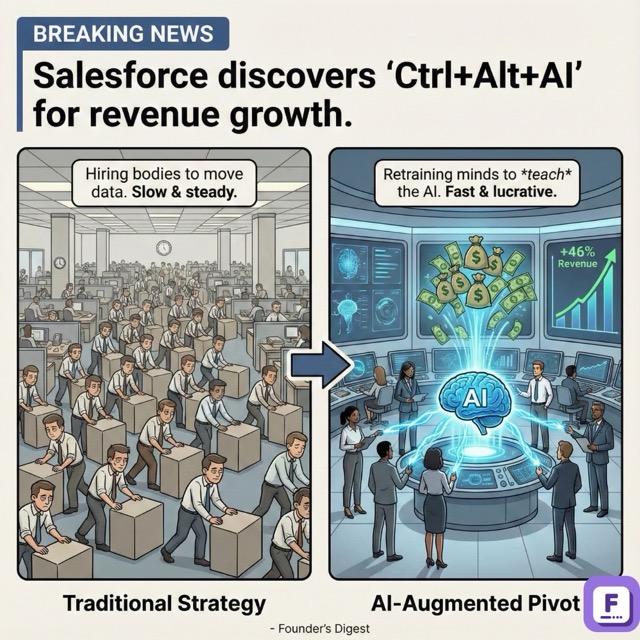
The growth story hides a structural pivot. Salesforce is reshaping its 14,000-person India workforce—its second largest globally—from back-office support to “AI trainers” and “forward-deployed engineers” for its new Agentforce platform.
This changes the talent market immediately. The largest SaaS employer in the region is now aggressively hiring for the same high-value AI skills as early-stage startups, but with public company resources.
WHY IT MATTERS
- For Indian SaaS founders: Engineering burn rates increase 20-30% over 18 months as Salesforce sets a new salary floor for AI talent in Bangalore and Hyderabad.
- For global enterprise buyers: The “offshore support” model is dead—expect India-based teams to drive high-value Agentforce implementations rather than just ticket resolution.
- For IT Services (Infosys/TCS): Salesforce is insourcing the highest-margin work (AI agent deployment) while leaving lower-margin integration work to partners.
BY THE NUMBERS
- Salesforce India Revenue: INR 13,384 Cr ($1.58B) in FY25, up 47% YoY.
- Net Profit: INR 1,292 Cr, up 45% YoY.
- Headcount: 14,000+ employees, the company’s second-largest hub outside the US.
- Expense Growth: Employee costs rose 44% to INR 9,120 Cr, signaling wage inflation.
- Training Scale: 75,000 professionals trained on Salesforce skills in 2025 alone.
- Competitor Comparison: Zoho reported ~$1B+ revenue (FY23) with ~30% growth; Freshworks reported $720M revenue (FY24) with ~21% growth.
COMPANY CONTEXT
Salesforce entered India late compared to Oracle or Microsoft but accelerated under Arundhati Bhattacharya (former SBI Chairperson) since 2020. The strategy shifted from sales outpost to “Center of Excellence” (CoE) covering product, engineering, and customer success.
The launch of Agentforce in late 2024 marked a pivot point. The company requires human “trainers” to fine-tune AI agents for enterprise use cases—work that requires technical context but is labor-intensive. India is the primary hub for this “human-in-the-loop” infrastructure.
Competitively, Salesforce sits between Zoho (bootstrapped, high volume) and Freshworks (SMB focus). By moving upmarket into “Agentic Enterprise” work, Salesforce creates a new tier of engineering demand that neither competitor has fully established.
COMPETITOR LANDSCAPE
Zoho remains the margin leader, generating ~$1B+ revenue with profitable growth and a rural hub strategy that insulates it from metro-city wage wars. Its “culture-first” retention creates a moat against Salesforce’s cash compensation.
Freshworks (NASDAQ: FRSH) faces the most direct pressure. With $720M revenue and 21% growth, it competes for the same mid-senior engineering talent in Chennai and Bangalore. Freshworks is paring losses (down 31% in FY24) just as Salesforce inflates the cost of talent required to build competing AI features.
Microsoft and Google operate massive India GCCs (Global Capability Centers) but have historically focused on core infrastructure. Salesforce’s push is different: it targets application-layer AI engineers, the exact profile needed by every B2B SaaS startup in 2025.
INDUSTRY ANALYSIS
The era of “cost arbitrage” is transitioning to “talent arbitrage.” Global Capability Centers (GCCs) in India are moving up the value chain.
Salesforce’s 47% revenue growth validates the “India for the World” thesis—but the 44% spike in employee costs shows the price tag is rising. Senior AI engineers in India now command salaries of INR 40-80 LPA ($48k-$95k), narrowing the gap with Eastern European hubs.
Public sentiment among founders in Bangalore is shifting from “hiring is hard” to “hiring is impossible.” When a $300B giant pivots 14,000 people toward AI, it sucks the oxygen out of the recruitment market for 6-12 months.
FOR FOUNDERS
- If you’re hiring AI engineers in India: You cannot win a cash bidding war against Salesforce. Compete on equity upside and scope.
- Action: Offer “forward-deployed” equity packages with 4-year vests, and emphasize zero-bureaucracy shipping velocity. Salesforce engineers will spend 50% of their time on compliance and training; yours can ship.
- If you’re building vertical AI agents: Salesforce’s Agentforce is a horizontal platform.
- Action: Go deep on proprietary data workflows in niche verticals (legal, medical, industrial) before Salesforce’s generalist agents become “good enough” for your customers. You have a 12-month head start.
FOR INVESTORS
- For India-US cross-border SaaS portfolios: Expect burn rates to spike. The “cheap India engineering” thesis is eroding for top-tier talent.
- Action: Audit portfolio salary bands. If a company budgets $30k for a senior AI engineer, they will fail to hire. Adjust models to $50k-$60k for quality talent.
- For Series A/B due diligence: Scrutinize the “moat.”
- Signal to watch: If a startup’s primary advantage is “we have a large team in India labelling data,” Salesforce just commoditized that structure. Look for proprietary data access, not just labor arbitrage.
THE COUNTERARGUMENT
The counterargument: Salesforce’s hiring might actually slow down as AI increases efficiency.
The company is training existing employees rather than net-new hiring for all roles. If Agentforce works as advertised, it reduces the need for massive implementation armies. The 44% rise in employee costs could be a one-time adjustment for retention and retraining, not a permanent inflation of the cost basis.
This would be correct if: (1) Salesforce’s headcount stays flat in FY26 while revenue grows, or (2) Agentforce deployments prove to be largely automated (self-serve) rather than service-heavy. Early data on “forward-deployed engineers” suggests the latter is unlikely in the near term.
BOTTOM LINE
Salesforce has signaled the end of low-cost Indian engineering for global SaaS.
India is now the R&D engine for the AI agent layer. Founders and investors must adjust their unit economics: the talent is better than ever, but the discount is disappearing. Scale accordingly.
