THE SITUATION
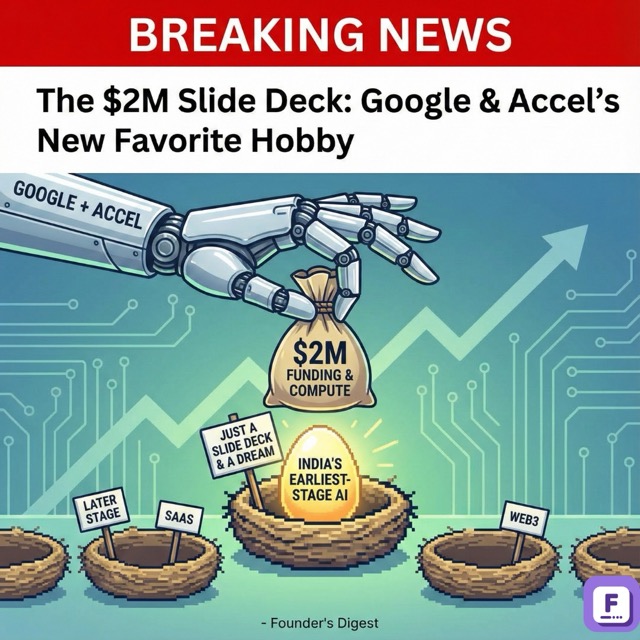
Google and Accel launched a partnership on November 25, 2025, to co-invest up to $2M per startup in India’s early-stage AI ecosystem. The deal combines equity ($1M from each) with up to $350,000 in compute credits and technical access to DeepMind/Gemini.
The timing targets the “sovereign AI” shift. With India’s GenAI startup base growing 3.6x in 24 months, Google is intervening at the formation stage. This is not charity; it is a calculated wedge to secure future enterprise consumption in a market where Google Cloud trails significantly behind AWS.
WHY IT MATTERS
- For Cloud Competitors (AWS/Azure): Customer acquisition costs rise. Google is buying the “default stack” status for the next generation of high-growth Indian startups before they write a single line of production code.
- For Early-Stage Founders: The seed valuation floor stabilizes. A $2M check plus $350k in non-dilutive compute sets a “quality” benchmark, effectively pricing out smaller domestic angels who cannot offer infrastructure subsidies.
- For Enterprise Buyers: Downstream integration deepens. Startups built on Google’s stack today become the enterprise vendors of 2027 that natively integrate with Workspace and Gemini, increasing switching costs.
BY THE NUMBERS
- Deal Structure: Up to $2M equity ($1M Accel + $1M Google) per startup.
- Compute Subsidy: Up to $350,000 in credits per company.
- Google Market Share: ~10-11% of cloud infrastructure (vs. AWS ~32%, Azure ~23%).
- Indian AI Growth: 240+ GenAI startups active in H1 2024, up 3.6x YoY.
- Funding Context: Sarvam AI raised $41M (Series A, Dec 2023); Krutrim raised $50M (Series B, Jan 2024).
CONTEXT
Google has historically played a “platform” role in India, investing $10B via its Digitization Fund since 2020. However, its cloud adoption has lagged. While AWS capitalized on early entry (2006) and Microsoft leveraged enterprise sales, Google remained a distant third.
Accel brings the validation. As the backer of Flipkart, Swiggy, and Freshworks, their “Atoms” program acts as a primary filter for India’s highest-potential founders. By attaching itself to Accel’s deal flow, Google outsources the vetting process while securing the infrastructure rights.
COMPETITOR LANDSCAPE
AWS (Amazon): Dominates with ~32% share. Their “Activate” program offers credits but lacks the direct equity alignment of the Google/Accel model. They compete on ubiquity and maturity, not venture risk.
Microsoft (Azure): Holds ~23% share. Their leverage is the OpenAI partnership, which often defaults founders to Azure for GPT-4 access. Google’s program specifically targets this by bundling Gemini access to break the OpenAI/Azure default.
Local Sovereign AI:
- Sarvam AI: Raised $41M to build Hindi-first LLMs; competing on model relevance.
- Krutrim: Raised $50M at $1B valuation; building a full stack including custom silicon to reduce reliance on US cloud providers entirely.
INDUSTRY ANALYSIS
The Indian market is shifting from “wrapper” applications to vertical integration. In 2023, funding flowed to native models (Sarvam, Krutrim); in late 2025, capital is moving toward “applied AI” that solves specific Indian infrastructure problems (healthcare, logistics).
Sentiment among founders has shifted from “access to models” to “cost of compute.” With 80% of Indian GenAI startups earning <$100k revenue, the GPU bill is the primary death risk. Google’s $350k credit line isn’t just a perk; for many, it is their entire runway extension.
Capital flows reflect this maturity. While early-stage deal counts dropped in 2024, the check sizes for credible AI teams are increasing. Investors are effectively paying a premium for technical moats, and Google is subsidizing that moat construction.
FOR FOUNDERS
- If you’re building for “Bharat” (Tier 2+ India): Apply for the cohort immediately (Deadline Jan 26, 2026). The $350k compute credit allows you to train smaller, vernacular-specific models that are cost-prohibitive on standard commercial API rates.
- If you’re assessing cloud providers: Do not let the $350k credits blind you to long-term lock-in. If your architecture relies heavily on Gemini-specific features, your migration costs in Series B will be fatal. Keep your inference layer portable.
- If you’re raising Seed/Pre-Series A: Use this valuation benchmark. If Google/Accel are pricing rounds at implied $10M-$12M caps (standard for $2M entry), refuse dilution below this floor from domestic angels.
FOR INVESTORS
- For Series A investors: The “Accel Atoms x Google” cohort is your pre-qualified deal flow for Q3 2026. Watch for the “Demo Day.” Companies graduating this program have cleared both technical (Google) and commercial (Accel) diligence.
- For emerging market thesis: Monitor the “sovereign AI” layer. Google’s aggressive entry suggests they see India not just as a consumer market, but as a development hub that will export AI tools to the Global South.
- Signal to watch: Portfolio companies switching from OpenAI APIs to Gemini. If this happens, Google’s subsidy strategy is working, and Azure’s grip on the application layer is slipping.
THE COUNTERARGUMENT
The counterargument: This is too little, too late to dent AWS’s dominance.
Google’s 10% market share is structurally lower than AWS’s 32%. A $2M check split across equity and credits for a handful of startups is a drop in the ocean compared to AWS’s entrenched ecosystem of 10+ years. Furthermore, $350k in credits burns fast if a startup is doing serious model training—Sarvam needed $41M to build a real model. If these startups are merely building “wrappers,” they will churn as soon as the credits expire, returning to whichever cloud offers the cheapest commodity inference.
This view would be correct if the cohort produces only thin application layers rather than defensible vertical AI companies.
BOTTOM LINE
Google is buying future market share at a discount. By locking in the highest-potential Indian founders at the formation stage, they are attempting to prevent an “Azure default” scenario. Cloud competitors must respond with equivalent equity-aligned incentives by Q2 2026 or watch the next wave of Indian unicorns grow up on Google Cloud.
