THE SITUATION
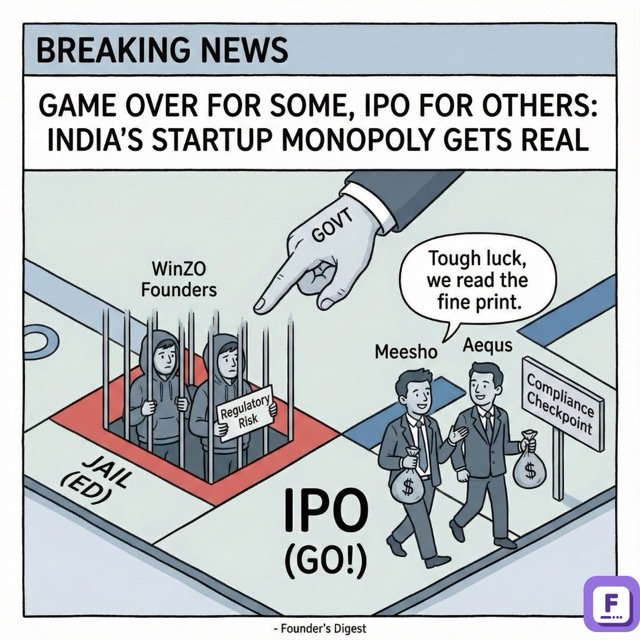
The Enforcement Directorate arrested WinZO founders Saumya Singh Rathore and Paavan Nanda on November 27, 2025, freezing ₹505 crore in assets. The specific charge is damning: using “bot” algorithms to rig games against users while claiming a peer-to-peer model, and retaining ₹43 crore in user funds after the Real Money Gaming (RMG) ban took effect in August 2025.
This enforcement action coincides directly with the primary market’s shift to safety. While gaming founders face jail time, e-commerce giant Meesho and manufacturer Aequs open their IPOs on December 3, targeting a combined ₹6,300 crore raise.
The signal is absolute: The government has moved from taxing gray zones (28% GST) to criminalizing them. Capital is rotating immediately from “growth hacks” to tangible, compliant operations.
WHY IT MATTERS
- For gaming unicorn founders: Regulatory non-compliance is no longer a civil penalty; it is an arrestable offense. The “operate until banned” playbook now carries personal liability risks that VCs cannot insure against.
- For late-stage investors: The “Compliance Premium” explodes. Valuation multiples for regulated sectors (manufacturing, commerce) expand, while “gray zone” sectors (gaming, crypto, unregulated lending) face immediate write-downs.
- For IPO applicants: The window is open only for clean models. Regulators are effectively clearing the deck for “nation-building” listings (Aequs/manufacturing, Meesho/commerce) by making examples of extractive models.
BY THE NUMBERS
- WinZO assets frozen: ₹505 crore, including mutual funds and fixed deposits (Source: ED Statement, Nov 2025)
- Alleged illicit gains: ₹177 crore generated via algorithmic manipulation (Source: Economic Times, Nov 2025)
- Meesho IPO size: ₹5,421 crore at a $5.6B valuation (Source: IPO Filing, Nov 2025)
- Aequs IPO size: ₹922 crore, valuing the manufacturer at ~₹8,300 crore (Source: Red Herring Prospectus)
- RMG regulatory timeline: Real Money Gaming formally banned under the 2025 Act effective Oct 1 (Source: Gazette of India Notification)
- Meesho FY25 revenue: ₹9,390 crore projected, with net losses narrowing to ₹108 crore (Source: DRHP Update)
COMPETITOR LANDSCAPE
In gaming, the blast radius covers everyone. Dream11 and MPL now face an existential crisis; if the ED classifies algorithms as “fraud” rather than “house edge,” their core engagement loops are illegal. Competitors like Gameskraft have already seen accounts frozen. The sector is uninvestable until the legal standard for “bots” is defined.
In commerce, Meesho’s $5.6B valuation pegs it below Flipkart but above niche players. Its clear regulatory standing (marketplace model) creates a moat against quick-commerce players still battling “dark store” labor regulations.
In manufacturing, Aequs has zero digital regulatory risk. Its competitors are global supply chains, not local regulators. This safety makes it a defensive haven for domestic institutional investors (DIIs).
INDUSTRY ANALYSIS
The Indian startup ecosystem is undergoing a violent bifurcation. On one side, “digital arbitrage” models (gaming, predatory lending) are being systematically dismantled via the PMLA (Prevention of Money Laundering Act). The arrest of high-profile founders proves the state will pierce the corporate veil to punish non-compliance.
On the other side, “nation-building” assets are being fast-tracked. The IPO pipeline for December—led by Meesho and Aequs—is not a coincidence. SEBI and the Finance Ministry are signaling that public markets are for businesses that build assets, not those that extract rents.
Public sentiment has turned. LinkedIn feeds are silent on “supporting founders” in the WinZO case, a stark contrast to the support for Paytm earlier. The accusation of rigging games against users destroys the “innovation” defense. Capital flows reflect this: VCs are freezing gaming term sheets and oversubscribing to manufacturing and clean-commerce rounds.
FOR FOUNDERS
- If you operate in a “gray” regulatory zone: Halt expansion immediately. Audit your algorithms for any mechanism that could be construed as “rigging” outcomes. If you have “house bots,” shut them down tonight.
- If you are preparing for IPO: Scrub your books of any “aggressive” tax structures. The Meesho IPO proves that investors will pay for clean governance. Resolve outstanding litigations now, even at a cost—you cannot list with an ED shadow.
- If you are building “real assets” (SaaS/Infra/Mfg): Your valuation just went up. Differentiate yourself from “arbitrage” models. Pitch “regulatory boredom” as a feature.
FOR INVESTORS
- For gaming portfolios: Mark holdings down by 50-80%. The liquidity window is sealed. Even if companies survive, unit economics will collapse without the “house edge” provided by bots/algorithms.
- For pre-IPO allocations: Overweight Aequs and Meesho. They represent the “sanctioned” economy. The risk of regulatory intervention in aerospace manufacturing is zero compared to consumer internet.
- Watch for: The “Gameskraft” contagion. If ED summons extend to other major gaming unicorns in the next 14 days, the entire sector (including fantasy sports) becomes a write-off for FY26.
THE COUNTERARGUMENT
The counterargument: The WinZO arrests might be a specific reaction to fraud (the bots) rather than a systemic attack on the sector. If the courts grant bail quickly and rule that “bots” are industry standard for liquidity, the panic may subside. The “RMG ban” might face constitutional challenges, as seen with previous state bans, potentially reopening the sector.
This would be correct if: (1) The ED fails to prove the “rigged algorithm” charge, (2) The Supreme Court stays the RMG ban, or (3) WinZO founders are exonerated quickly. However, with ₹505 crore frozen and PMLA charges invoked, the process is the punishment.
BOTTOM LINE
Regulatory arbitrage is dead. The WinZO arrests prove that “move fast and break things” now leads to prison, not profit. Capital will aggressively rotate into “boring,” compliant IPOs like Meesho and Aequs, leaving the gray-zone digital economy to face a multi-year winter.
