THE SITUATION
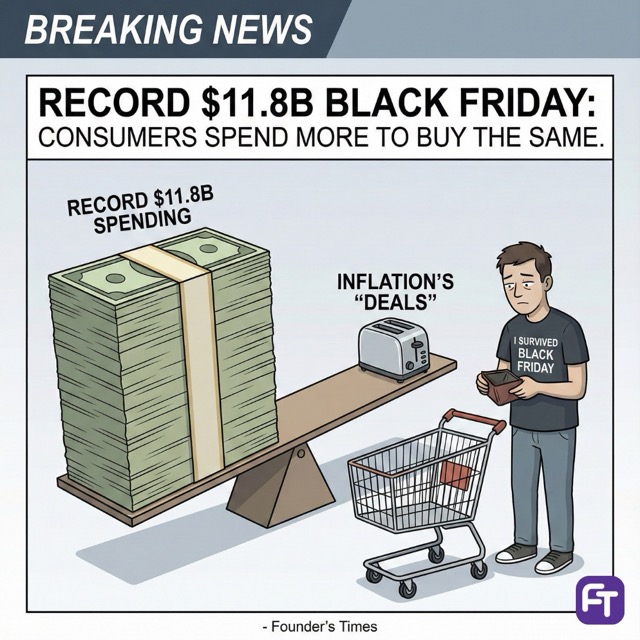
U.S. consumers spent a record $11.8 billion online on Black Friday 2025, a 9.1% increase year-over-year. Mobile devices drove 55.2% of this revenue, cementing the shift to handheld commerce.
The topline growth is a mirage. While revenue rose, order volume dropped 1% and units per transaction fell 2%. Consumers are not buying more; they are paying higher prices for fewer items. To bridge the gap between stagnant wages and tariff-driven inflation, shoppers turned to debt: “Buy Now, Pay Later” (BNPL) usage jumped 8.9%, financing $747.5 million of spend in a single day.
This isn’t organic demand growth. It is inflation-driven revenue supported by unsecured credit.
WHY IT MATTERS
- For mid-market retailers: Customer acquisition costs (CAC) spike 20-30% in Q1 2026. Retention fails as discount-hunting shoppers (who bought 2% fewer units) churn immediately after the holidays.
- For BNPL providers: Delinquency risk rises in 60 days. Consumers stacking installment plans across multiple platforms (Affirm, Klarna, PayPal) create a “shadow debt” bubble invisible to traditional credit bureaus.
- For logistics carriers: Last-mile margins compress. The disconnect between high revenue and lower unit volume complicates route density planning, while free shipping demands erode per-package yield.
BY THE NUMBERS
- Total Online Spend: $11.8B, up 9.1% YoY (Source: Adobe Analytics, Nov 2025)
- BNPL Volume: $747.5M, up 8.9% YoY (Source: Adobe Analytics, Nov 2025)
- Mobile Share: 55.2% of total sales (Source: Adobe Analytics, Nov 2025)
- Shopify Merchant GMV: $6.2B global record (Source: Shopify, Nov 2025)
- Unit Volume: Down 2% YoY (Source: Salesforce, Nov 2025)
- Order Volume: Down 1% YoY (Source: Salesforce, Nov 2025)
- AI Influence: $3B of U.S. sales driven by AI agents/recommendations (Source: Salesforce, Nov 2025)
COMPANY CONTEXT
Shopify (NYSE: SHOP) serves as the primary barometer for the independent economy. The platform powered $11.5B in sales during the 2024 Black Friday/Cyber Monday weekend.
In 2025, Shopify merchants generated a record $6.2B on Black Friday alone, with peak sales hitting $5.1 million per minute. This continues the platform’s shift from “DTC launchpad” to enterprise infrastructure; Shopify now powers major brands like Mattel and Glossier, competing directly with Salesforce Commerce Cloud.
Crucially, Shopify’s take rate (revenue as a % of GMV) has increased via “Merchant Solutions”—payments, shipping, and capital. The company’s growth now depends less on new merchant signups and more on the gross merchandise volume (GMV) flowing through existing stores.
COMPETITOR LANDSCAPE
Amazon dominates logistics but faces “discovery” pressure. Its launch of “Rufus” (AI shopping assistant) attempts to keep product search on-platform. However, Amazon’s ad-heavy interface is losing ground to social commerce discovery.
Walmart leverages omnichannel dominance. With 4,600 U.S. stores acting as fulfillment centers, Walmart wins on speed and grocery-adjacent cross-selling. Their marketplace volume grew 20%+ in 2025, attracting sellers looking for lower ad costs than Amazon.
Temu/Shein pressure the low end. These platforms capture the price-sensitive consumer who abandons domestic carts. Their impact forces U.S. retailers to deepen discounts to 25-30% to compete, destroying gross margins for undifferentiated brands.
INDUSTRY ANALYSIS
The funnel has fundamentally changed. In 2025, AI agents influenced $3 billion in U.S. sales. Consumers are no longer browsing catalogs; they are asking LLMs for recommendations.
This shifts power from “brand equity” to “algorithm optimization.” If a brand’s product data isn’t structured for AI retrieval (Amazon Rufus, Google Gemini, OpenAI), it effectively doesn’t exist.
Sentiment among operators is cautious. On earnings calls, retail CEOs cite “choiceful” consumers—a euphemism for shoppers who only buy on promotion. Private equity activity confirms this: capital is flowing into “Retail Tech” (profitability tools, returns management) rather than “DTC Brands” (growth plays). Investors have stopped funding customer acquisition; they are funding efficiency.
FOR FOUNDERS
- If you’re a DTC brand founder: The “growth at all costs” era is dead. Audit your contribution margin immediately—if you rely on a 30% discount to move inventory, your unit economics are broken.
- Action: Pivot marketing spend to retention (SMS/Email) before Q1. Stop buying low-quality traffic from Meta/TikTok that doesn’t convert without a coupon.
- If you’re building Retail Tech: Pitch “profit protection,” not “sales growth.”
- Action: Position your tool as a way to reduce returns or automate support. Retailers will cut “growth” software in 2026 but will pay for anything that saves opex.
- If you’re raising a Series A in Commerce: Investors will penalize you for high BNPL dependency.
- Action: Show cohort retention data excluding BNPL customers. Prove your customers can afford your product without financing.
FOR INVESTORS
- For Consumer Discretionary portfolios: Short retailers with high inventory levels and low cash.
- Action: The “unit volume down 2%” metric is the smoking gun. Companies that ordered inventory expecting 5% volume growth are sitting on dead stock. Expect heavy writedowns in Q1 2026 earnings.
- For FinTech allocations: Limit exposure to pure-play BNPL providers.
- Signal to watch: Watch for a spike in “friendly fraud” chargebacks in February 2026. This is the leading indicator of a consumer who can’t pay their installment loans.
- For Logistics investments: Bet on “Reverse Logistics.”
- Thesis: High BNPL usage correlates with high return rates (often >30% in apparel). Companies that handle returns efficiently (e.g., Happy Returns, Loop) will see volume surge in January.
THE COUNTERARGUMENT
The counterargument: The $11.8B spend represents genuine economic resilience, not debt-fueled desperation.
Wage growth in 2025 has tracked close to inflation, and unemployment remains historically low. The drop in “unit volume” could reflect a shift toward higher-quality, durable goods (premiumization) rather than inflation. If consumers are buying fewer, better items, this is a healthy structural shift, not a sign of weakness. Furthermore, the 8.9% BNPL growth might just be “method substitution”—consumers using interest-free installments instead of high-interest credit cards, which is a rational financial decision, not a distress signal.
This would be correct if: (1) Credit card delinquency rates remain flat in Q1 2026, and (2) Luxury/Premium categories outperform discount tiers in post-holiday earnings.
BOTTOM LINE
The record $11.8B figure is a “sugar high” fueled by price hikes and installment debt. Retailers are trading margin for topline revenue while selling fewer actual units. The hangover hits in Q1 2026—winners will be the infrastructure providers (Shopify, Amazon) who tax the transaction; losers will be the brands who paid for the discount.
