THE SITUATION
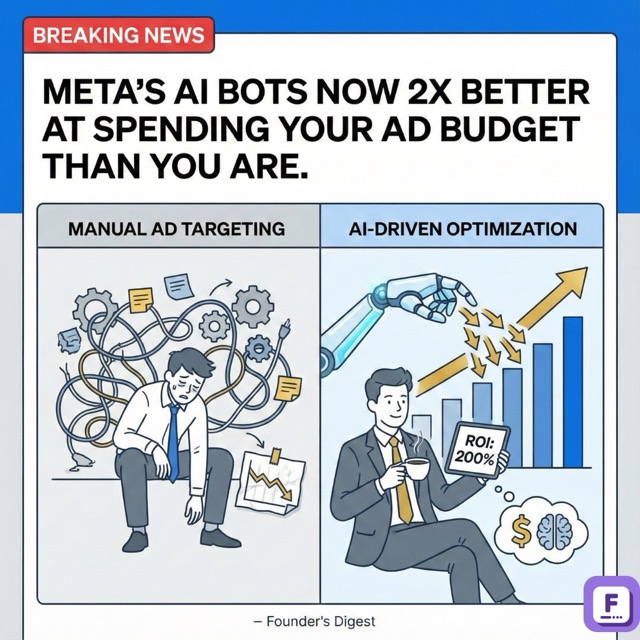
Meta has integrated its Advantage+ AI tools directly into the core ad creation flow, effectively making “black box” automation the default setting for its 10 million advertisers. The company claims these updates increase ad effectiveness by 2x.
This is the end of the post-IDFA recovery phase and the beginning of the “Generative Ad” era. Meta is no longer just optimizing distribution; it is now generating the creative assets themselves. By defaulting users into Advantage+ workflows, Meta removes the last levers of manual control—audience targeting, placement, and bidding—from human operators.
The immediate impact: performance now correlates 100% with creative volume and velocity, not media buying skill. Small teams using GenAI tools can now outperform large agencies dependent on manual optimization.
WHY IT MATTERS
- For Direct-to-Consumer (DTC) Brands: Customer Acquisition Costs (CAC) stabilize but creative production costs spike. You are no longer paying for “access” to an audience; you are paying for the “creative variance” required to satisfy the algorithm.
- For Digital Agencies: The “media buyer” retainer model collapses within 12 months. Clients will not pay 15% of spend for a button-pusher when the algorithm does it better. Value shifts entirely to “creative strategy” and “asset production.”
- For AdTech Vendors: Third-party optimization tools become redundant. If Meta controls the targeting and the creative generation, the “optimization layer” of the ad stack evaporates.
BY THE NUMBERS
- Q3 2025 Revenue: $51.2B, up 26% YoY (Source: Meta Q3 2025 Earnings)
- AI Infrastructure Spend (CAPEX): $19.4B in Q3 2025 alone; projected $70-72B for full year 2025 (Source: Meta Investor Relations)
- Ad Pricing: Average price per ad increased 11% YoY in late 2024 (Source: Marketing Dive)
- GenAI Adoption: 1 million+ advertisers used GenAI tools to create 15 million ads in a single month (Source: Meta Q3 2024 Earnings Call)
- Conversion Lift: Businesses using Image Generation tools see a 7% increase in conversions (Source: Meta Q3 2024 Earnings Call)
- Daily Active People: 3.29 billion across family of apps (Source: Meta Q3 2024 Earnings)
COMPANY CONTEXT
Meta pivoted to an AI-centric strategy following the 2021 Apple iOS privacy changes (ATT), which cost the company an estimated $10B in lost revenue by severing its signal to user data.
In response, Meta rebuilt its ad stack from the ground up using AI to model missing data (Advantage+). This worked: the stock recovered from a low of ~$90 in 2022 to record highs in 2024/2025.
The current phase—Generative AI—moves beyond finding the user to creating the ad that converts them. With $70B+ allocated to CAPEX in 2025, Meta is betting that owning the compute infrastructure will allow it to brute-force ad performance better than any human competitor.
COMPETITOR LANDSCAPE
Google remains the primary peer with “Performance Max” (PMax). Like Advantage+, PMax removes manual controls. However, Google controls the intent layer (Search), while Meta controls the demand generation layer (Social). Google reported $49.4B in search revenue in Q3 2024 (+12% YoY), but media buyers report PMax often cannibalizes branded search traffic—a problem Meta’s Advantage+ avoids.
TikTok launched “Smart Performance Campaigns” to compete, but struggles with conversion consistency in Western markets compared to Meta. While TikTok captures attention, Meta captures the wallet: Meta’s conversion rates average 9.2% vs. TikTok’s fluctuating performance.
The Trade Desk represents the “open internet” alternative, positioning itself as the transparent anti-walled garden. While they grew revenue 18% to $739M, they lack the proprietary first-party data that allows Meta to train its generative models effectively.
INDUSTRY ANALYSIS
The structure of digital advertising is inverting. For a decade, success meant “hacking” the algorithm with precise interest targeting (e.g., “Lookalike 1%”). That era is over.
The shift is documented in buyer sentiment. On Reddit and industry forums, veteran media buyers report that manual targeting now consistently underperforms Advantage+. The complaint has shifted from “targeting is broken” to “Advantage+ spends budget too fast on one creative.” This confirms the new dynamic: the algorithm finds the winner instantly, and if you don’t have enough creative variance, it fatigues the audience in days.
Capital flows reflect this. Venture funding is moving away from “ad optimization” SaaS and toward “Generative Creative” platforms (e.g., Typeface, Jasper, AdCreative.ai). Investors realize the bottleneck is no longer buying media, but filling the pipe.
Simultaneously, “Agency” margins are under attack. With Meta automating the labor-intensive part of ad management, brands are bringing media buying in-house and hiring “Creative Strategists” instead. LinkedIn hiring data suggests a surge in “Creative Strategist” roles, while “Media Buyer” roles stagnate.
FOR FOUNDERS
- If you’re a DTC Founder: Your media buyer is not your most important hire anymore—your creative producer is. Audit your creative velocity. If you are not testing 5-10 new static/video hooks per week, you will lose to competitors who feed the Advantage+ algorithm more data. Action: Shift budget from “agency fees” to “content production” immediately.
- If you’re building AdTech: Do not build a “better ad manager.” Meta will kill you by defaulting it into the interface. Build “middleware” that connects inventory data to creative generation. The opportunity is in generating the asset, not placing it.
- If you run a Marketing Agency: Pivot to a “Creative-First” model within 6 months. Stop charging % of spend for media buying (which AI does for free). Charge for “Creative Performance Packs”—guaranteed delivery of tested winning assets. If you don’t own the creative, you have no leverage.
FOR INVESTORS
- For AdTech Portfolios: Short companies that rely on “manual optimization” or “bid management” features. These are features, not products, and Meta just made them free.
- For B2B SaaS Bets: Look for “Creative Infrastructure” plays—tools that allow teams to manage, tag, and iterate on thousands of video assets. The bottleneck is now file management and creative analytics, not bid management.
- For Public Market Allocators: Meta’s $70B CAPEX spend is a massive moat. No sub-$50B company can compete with this compute power. The “Efficiency Gap” between Meta and the open web is widening. Stick with the hyperscalers; the “open web” ad tech players will suffer margin compression as they try to rent compute they don’t own.
THE COUNTERARGUMENT
The counterargument: Advantage+ creates a “Race to the Bottom” where ad costs inflate indefinitely.
If every advertiser uses the same “black box” algorithm, they all bid on the same high-intent users, driving CPMs up. Early data shows CPMs on Advantage+ can be higher than manual setups. Furthermore, if the AI generates the creative and targets the audience, brands lose their differentiation, turning advertising into a commodity tax where the only winner is Meta.
This view would be correct if: (1) Conversion rates plateau (data shows they are rising), or (2) Users reject AI-generated ads (current engagement data shows time-on-app increasing 8%). For now, the efficiency gains outweigh the cost inflation—but the risk of “CPM inflation” is real for 2026.
BOTTOM LINE
Manual ad targeting is dead. The “media buyer” who adjusts bids is a legacy artifact.
In 2025, Creative is the Targeting. Companies that can operationalize the production of high-quality, high-variance creative assets will win. Those waiting for the return of “granular control” will bleed margin until they are acquired or insolvent. The algorithm is the CEO now.
