THE SITUATION
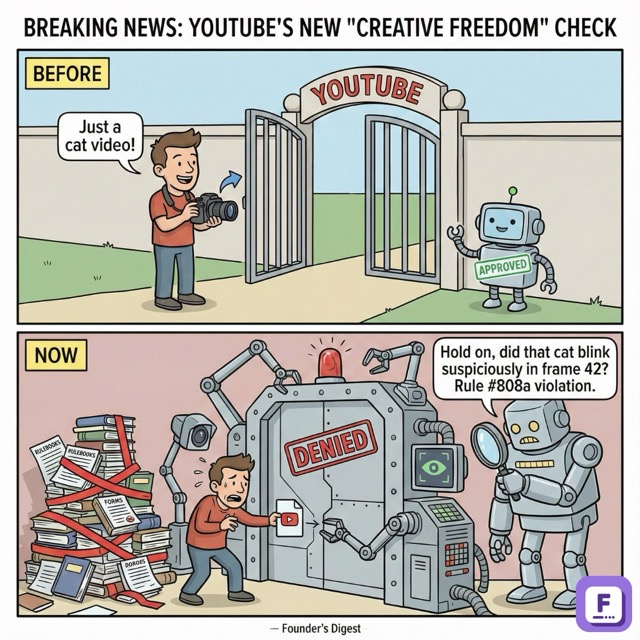
YouTube expanded its “Checks” feature on November 23, 2025, to screen uploads for Community Guidelines violations before publication. Previously limited to copyright and ad suitability, the system now flags potential strikes—including hate speech, nudity, and self-harm—during the upload flow.
This effectively shifts moderation from post-publication punishment to pre-publication compliance. Creators now receive a “fix it or face a strike” warning before a single viewer sees the video. The rollout is currently in limited testing but signals a platform-wide standard for 2026.
WHY IT MATTERS
- For professional creators: Operational risk drops significantly. The “upload and pray” dynamic—where a surprise strike could derail a channel instantly—is replaced by a feedback loop that allows for edits before damage occurs.
- For brand advertisers: Inventory safety increases immediately. By catching violations at the upload stage, YouTube reduces the volume of “risky” content that briefly exists in the wild before automated takedowns catch it.
- For AI startups: The compliance layer just became a moat. YouTube is leveraging its massive proprietary dataset to offer free, real-time compliance checking that third-party tools cannot match without access to the internal decision engine.
BY THE NUMBERS
- YouTube Q3 2025 ad revenue: $10.3B, up 15% YoY (Source: Alphabet Earnings, Oct 2025)
- Shorts momentum: 70 billion daily views, now earning more revenue per watch hour than long-form in the US (Source: Music Business Worldwide, Oct 2025)
- Automated efficiency: 90%+ of removed videos are detected by AI before reaching 10 views (Source: Google Transparency Report, 2025)
- Combined revenue: $50B+ in ad and subscription revenue over the trailing 12 months (Source: Alphabet Earnings, Oct 2025)
- Moderation volume: 6.8M+ videos removed for child safety alone in the last reporting period (Source: Google Transparency Report)
COMPANY CONTEXT
YouTube has methodically transitioned from a user-generated content (UGC) repository to a professional broadcast platform. The pivotal “Adpocalypse” of 2017 forced the company to prioritize brand safety over raw library growth. Since then, features like the Partner Program (YPP) requirements (1,000 subs/4,000 hours) and the original “Checks” system (2021) have served as filters to professionalize the creator base.
The platform is now a dual-engine giant: capturing TV budgets with long-form content on living room screens while fighting TikTok for mobile attention with Shorts. This move reinforces the “TV” side of the strategy—ensuring content is broadcast-safe before it airs.
COMPETITOR LANDSCAPE
TikTok remains the primary threat for attention but operates on a “post-publish” moderation model heavily reliant on algorithmic suppression rather than pre-publish feedback. This creates a volatile environment for creators who often find videos “shadowbanned” without explanation.
X (formerly Twitter) positions itself as the “free speech” alternative with looser moderation. While this attracts edge-case content, it alienates the premium brand advertisers that fuel YouTube’s $10.3B quarterly ad engine.
Instagram/Reels sits in the middle, leveraging Meta’s moderation infrastructure, but lacks the specific “pre-check” workflow that treats creators like production studios. YouTube’s move is a distinct step toward enterprise-grade creator tools that competitors do not offer.
INDUSTRY ANALYSIS
The “Creator Economy” is maturing into the “Media Economy.” The expansion of pre-publish checks is the technical manifestation of this shift. We are moving away from a world where platforms passively host content to one where they actively govern production standards through software.
Public sentiment among top-tier creators is shifting from “freedom” to “stability.” LinkedIn discussions and industry discord servers show that full-time creators prefer strict, transparent rules over vague, uneven enforcement. They view compliance tools as business insurance.
Capital flows follow this stability. Investors are increasingly wary of platforms with “wild west” moderation risks (regulatory fines, ad boycotts) and are consolidating bets on platforms that can guarantee brand safety at scale.
FOR FOUNDERS
- If you’re building creator tools: Pivot away from basic analytics and toward “pre-compliance” assistance. Creators need tools that help them edit for safety before the upload process begins.
- If you’re building a UGC platform: Automated moderation is no longer optional—it’s table stakes for monetization. You cannot compete for ad dollars in 2026 without a “safety first” architecture that protects brands from day one.
- If you’re a media startup: Build your workflows around YouTube’s compliance standards. Treat the “Checks” step as your final quality assurance pass, not an annoyance.
FOR INVESTORS
- For YouTube-focused portfolios: Bullish. This reduces the “key person risk” of top creators getting banned for accidental violations, stabilizing revenue streams for creator-led media businesses.
- For “Free Speech” platform bets: Bearish. As YouTube professionalizes, it captures the lucrative center of the market. Alternative platforms are left with the unmonetizable tail of content that fails these checks—high liability, low revenue.
- Signal to watch: Monitor the “false positive” rate of these new checks. If high-profile creators complain about over-censorship, it could open a window for a competitor—but only if that competitor has a viable monetization engine.
THE COUNTERARGUMENT
The counterargument: This creates a “chilling effect” that sanitizes the platform into boredom. By inserting AI governance directly into the creative workflow, YouTube encourages self-censorship. Creators might preemptively cut edgy but compliant humor just to avoid the hassle of a yellow flag. If the algorithm is overly sensitive (which early tests suggest it can be), the platform risks losing the raw authenticity that made it valuable in the first place.
This would be correct if: (1) Viewers start migrating to X or Rumble in significant numbers for “uncensored” entertainment, or (2) Shorts retention drops because content becomes too safe and corporate. Currently, data suggests advertisers care more about safety than viewers care about “edge.”
BOTTOM LINE
YouTube is closing the door on the “Wild West” era of the internet. By integrating compliance into the upload flow, they have effectively turned moderation into a product feature rather than a policing action. The platform is now enterprise software for media companies; creators who can’t professionalize their operations will be left behind.
YouTube Expands Pre-Publish Checks
The video above details the earlier iteration of YouTube’s Community Guidelines system, providing essential context for how this new expansion fits into their enforcement strategy.
