THE SITUATION
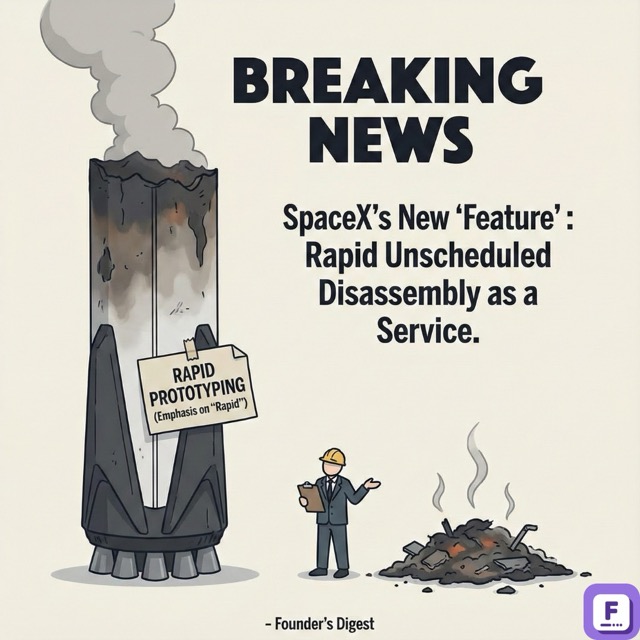
SpaceX’s upgraded Super Heavy booster exploded during a static fire test at Boca Chica earlier today. The anomaly occurred during the spin-prime test of the 33 Raptor engines, resulting in the total loss of the stage and significant ground infrastructure damage.
This is not just a testing failure; it is a schedule reset. The explosion comes just four days after leaked internal documents revealed SpaceX had already pushed its internal target for the Artemis III lunar landing to 2028—a full year behind NASA’s official 2027 schedule.
The immediate fallout: The “hardware rich” development strategy has hit a political wall. NASA acting leadership publicly flagged “frustration” with delays earlier this month, and this failure validates the agency’s decision to reopen the Artemis lander contract to competitors.
WHY IT MATTERS
- For NASA: The single-provider risk model is dead. Expect the agency to award a “sustained lander” contract to the Blue Origin-led National Team within 6 months to hedge against further Starship slips.
- For Starlink: IPO timelines push right. The Gen 2 Starlink constellation relies on Starship’s payload capacity; without it, network capacity remains capped by Falcon 9’s fairing volume, delaying the revenue growth story needed for a 2026 public offering.
- For Legacy Aerospace (Boeing/Lockheed/ULA): The “cost-plus” model gets a lifeline. This failure cools the Congressional pressure to cancel SLS (Space Launch System) in favor of commercial alternatives, securing the program’s $2.5B/launch budget through Artemis V.
BY THE NUMBERS
- Starship development cost: $5B+ self-funded by SpaceX to date.
- NASA HLS contract value: $2.89B (Fixed Price) for Artemis III.
- Current launch stats: 11 integrated flights, 5 failures/partial failures as of late 2025.
- SLS cost comparison: $2.2B–$2.5B per launch (expendable) vs. Starship’s target of <$100M.
- Required refueling flights: 12-16 tanker launches required for one lunar landing.
- Artemis III delay: Officially 2027; internal SpaceX estimates now show 2028.
- Raptor production: Raptor 3 engines aiming for 280 tonnes of thrust, but production rates remain the bottleneck.
COMPANY CONTEXT
SpaceX pivoted to Starship in 2016 with a philosophy of “hardware rich” iteration: build fast, fly fast, break things, learn. This contrasts sharply with NASA’s “mission assurance” culture, where failure is unacceptable.
While this approach captured the commercial launch market (Falcon 9 holds 80%+ global market share), it struggles with the specific constraints of the Artemis program. The complexity of orbital refueling—transferring cryogenic propellant between ships in zero gravity—remains the program’s highest technical risk.
Today’s explosion is the second loss of a major prototype in six months (following the Ship 36 anomaly in June). The optics of exploding hardware are now colliding with the political reality of a government contract that demands reliability.
COMPETITOR LANDSCAPE
Blue Origin (The National Team): The primary beneficiary. Jeff Bezos’s company is aggressively pitching its “Blue Moon” lander as the low-risk alternative. While their New Glenn rocket has faced its own delays, the lander architecture is simpler (fewer refueling flights) and aligns better with legacy NASA oversight.
SLS (Boeing/NASA): The incumbent remains the only super-heavy vehicle to successfully fly a lunar certified mission (Artemis I). Despite its exorbitant cost ($2.5B/launch) and lack of reusability, it offers political stability. Today’s SpaceX failure ensures SLS funding remains untouched in the upcoming federal budget cycle.
China (Long March 9): The geopolitical clock is ticking. China’s lunar program aims for a 2030 landing. If SpaceX slips to 2028/2029, the US “lead” narrows to a margin of error that makes Congress uncomfortable.
INDUSTRY ANALYSIS
The pendulum of space capital is shifting. From 2020-2024, investors poured money into “Starship-native” startups—companies building massive space stations or heavy manufacturing, assuming cheap, abundant lift was imminent.
That thesis is now paused.
Public sentiment has turned cautious. NASA’s solicitation for backup lander providers signals a retreat from “commercial-only” reliance back to “mixed-fleet” redundancy. We are seeing this in capital flows: late-stage VC funding for heavy-lift launch startups dropped 40% in Q3 2025, while funding for “space tugs” and orbital servicing (maximizing existing asset life) rose 25%.
The market realizes that while Starship will eventually work, the “2026 Mars colonization” rhetoric was marketing, not a timeline. The infrastructure layer will be built on Falcon 9 and Electron for at least another 36 months.
FOR FOUNDERS
- If you are building “Starship-native” hardware: You have a 24-month air gap. Pivot your prototype to fit inside a Falcon 9 fairing (5.2m diameter) immediately. Investors will not fund a roadmap dependent on a vehicle that just slipped to 2028.
- If you are raising Series A in space tech: The “cheap launch” narrative is dead for this cycle. Build your unit economics on $2,500/kg launch costs (Transporter missions), not the projected $100/kg of Starship. If you can’t make margins work at current prices, you don’t have a business.
- If you are competing in launch: Do not compete on mass. Compete on responsiveness. The Department of Defense is prioritizing “Tactical Responsive Space” (24-hour launch readiness) over raw tonnage. Starship is a freight train; build a motorcycle.
FOR INVESTORS
- For Deep Tech portfolios: Mark down valuations of companies whose sole distribution channel is Starship. The “platform risk” just realized.
- Action: Rotate capital into orbital transfer vehicles (OTVs) and life-extension services. With launch costs remaining high for longer, operators will pay premiums to keep existing satellites alive rather than replacing them.
- Signal to watch: Watch the NASA “Sustaining Lunar Development” awards in Q1 2026. If Blue Origin gets >$3B, the multi-provider model is locked in, and the “SpaceX Monopoly” thesis weakens.
THE COUNTERARGUMENT
The counterargument: This explosion saves time.
In the “fail fast” philosophy, losing a booster on the test stand costing $50M is preferable to losing a payload and pad infrastructure during a launch attempt. SpaceX has three other Super Heavy boosters in various stages of production at Starbase. The factory output is the real metric, not the flight rate.
If SpaceX identifies the root cause (likely the Raptor spin-prime plumbing) within 30 days and is back on the pad by January 2026, this “delay” is a blip. Unlike SLS, which takes two years to build a single core stage, SpaceX can replace hardware in months.
This view would be correct if NASA sticks to the “Option A” contract without diversifying. However, the political pressure to “beat China” likely outweighs the technical nuance of iterative development.
BOTTOM LINE
The era of “SpaceX invincibility” is paused. The hardware-rich strategy works for R&D but clashes with the political rigidity of a crewed lunar program.
For the next 24 months, the space economy runs on Falcon 9 rails, not Starship dreams. Plan your burn rates accordingly.
