THE SITUATION
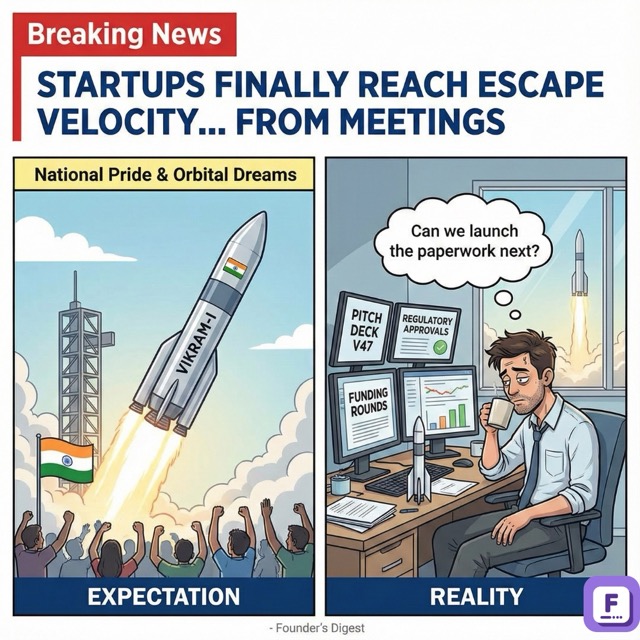
Skyroot Aerospace unveiled Vikram-1 on October 24, 2023, and is now preparing for its maiden orbital launch in early 2025. This marks India’s transition from state-monopoly space access to private commercial launch capability. The seven-story, solid-fuel rocket targets the small satellite market with a 300kg payload capacity to Low Earth Orbit (LEO).
This matters because the bottleneck for satellite operators is no longer building satellites, but booking a ride. While ISRO focuses on heavy national missions and SpaceX dominates bulk rideshare, Skyroot targets the underserved “taxi” market—dedicated delivery for small satellites to specific orbits.
WHY IT MATTERS
- For commercial satellite operators: Launch wait times shrink from 18+ months to <6 months as dedicated private options enter the market.
- For global investors: India becomes a viable hedge against US/China launch dominance, supported by 100% FDI rules enacted in February 2024.
- For the Indian supply chain: Manufacturing standards shift from “government cost-plus” to “commercial efficiency,” forcing Tier 2/3 vendors to modernize or die.
BY THE NUMBERS
- Total Funding: $99.8M raised across 9 rounds (Source: Tracxn, Nov 2023)
- Valuation: ~$520M (₹4,330 Cr) as of November 2023 (Source: Tracxn, Nov 2023)
- Payload Capacity: 300kg to Low Earth Orbit; 290kg to Sun-Synchronous Orbit (Source: Skyroot Specs, 2024)
- Projected Launch Date: Early 2025 (Source: Skyroot/Media Reports, 2024)
- Small Satellite Market: Growing from $6.9B in 2024 to $30.6B by 2034 (Source: GM Insights, 2024)
- Launch Cost Target: Aiming for competitive pricing vs. Rocket Lab’s ~$20,000/kg (Source: Industry Estimates/TechCrunch)
COMPETITOR LANDSCAPE
Skyroot Aerospace ($99.8M funding): Positions as the “Rocket Lab of the East.” Uses solid propulsion for the lower stages (simpler, cheaper storage) and liquid propulsion for orbital adjustment. Target: 300kg payload.
Agnikul Cosmos ($45.5M funding): Focuses on hyper-responsiveness with a mobile launchpad and a fully 3D-printed semi-cryogenic engine (Agnilet). Target: 100kg payload. Differentiator: Can launch from anywhere, not just Sriharikota. Status: Successful suborbital test (May 2024).
Rocket Lab (Public, $288M+ raised): The global benchmark. Delivers 300kg via the Electron rocket. Skyroot competes on price (labor arbitrage) and geography (access to different inclinations from India), but lags 7 years in flight heritage.
INDUSTRY ANALYSIS
The structural shift is regulatory. In February 2024, India amended FDI policies to allow 100% foreign investment in satellite manufacturing and 49% automatic route for launch vehicles. This effectively unlocks Western capital for Indian hardware.
Market sentiment has shifted from “can they build it?” to “can they launch it profitably?” Public markets are watching Rocket Lab (up ~300% in 2024) as a proxy. Capital is flowing into downstream applications (data analytics) under the assumption that launch costs will plummet.
FOR FOUNDERS
- If you’re building satellite hardware: Design for 300kg rideshare classes, not just SpaceX Transporter missions. Access to specific orbits (SSPO) via Skyroot creates new business models for earth observation that weren’t viable on bulk rideshares.
- If you’re in the aerospace supply chain: Audit your quality management systems (AS9100) immediately. Skyroot and Agnikul cannot use ISRO’s slow vendor network; they need automotive-speed production with aerospace precision.
- If you’re raising early-stage capital: Don’t pitch “lower cost launch.” Pitch “sovereign access” or “unique orbital insertion.” You cannot beat SpaceX on price ($5,000/kg); you must beat them on specificity.
FOR INVESTORS
- For DeepTech portfolios: The launch vehicle winners are largely decided (Skyroot, Agnikul). The next opportunity is in propulsion components and satellite buses. Watch for startups building “picks and shovels” for these launchers—fuel tanks, avionics, and separation systems.
- For growth-stage thesis: Skyroot’s $520M valuation prices in successful orbital execution. If Vikram-1 fails its maiden flight (statistically probable for new rockets), valuations in the sector will compress 20-30%.
- Signal to watch: Successful stage separation tests for Vikram-1. This is the technical milestone that de-risks the orbital attempt.
THE COUNTERARGUMENT
The counterargument: Small launch vehicles are a trap. SpaceX Transporter missions charge ~$5,000/kg, while small launchers like Rocket Lab (and Skyroot) must charge $15,000-$30,000/kg to break even.
Launch is a commodity. If customers prove price-sensitive, they will compromise on orbital precision to save 75% with SpaceX. Skyroot’s model depends on a robust market of customers willing to pay a premium for schedule control and specific orbits. If the small satellite market consolidates into constellations (Starlink/Kuiper), the demand for independent taxi launches evaporates.
BOTTOM LINE
Skyroot’s orbital entry validates India’s private space sector but faces a brutal unit economics war. Companies competing on “cheaper than US” survive; companies competing on “cheaper than SpaceX” die. Skyroot has 18 months to prove reliable orbital delivery before the window for a second global small-launch player closes.
