THE SITUATION
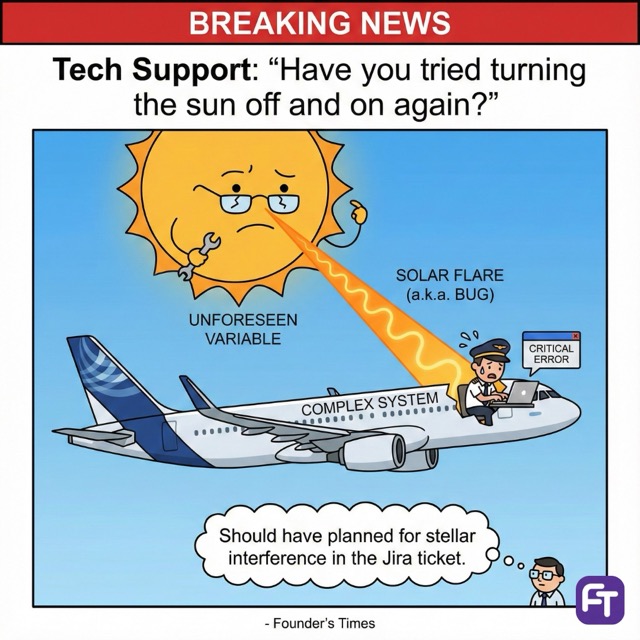
Airbus ordered immediate software updates for ~6,000 A320-family aircraft on November 29, 2025, following an EASA Emergency Airworthiness Directive. The trigger was an October 30 incident where a JetBlue A320 experienced an uncommanded pitch-down event due to solar radiation corrupting data in the Elevator Aileron Computer (ELAC).
The physics: The current peak of Solar Cycle 25 is causing Single Event Upsets (“bit flips”) in ELAC unit L104. While 4,000+ newer aircraft require only a software patch (hours of downtime), approximately 1,000 older jets require physical hardware replacements.
The immediate impact: Global operations for American, Delta, IndiGo, and Lufthansa are disrupted during peak travel windows. This is not a structural failure like the 737 MAX, but a vulnerability in digital fly-by-wire systems to environmental stress.
WHY IT MATTERS
- For A320 operators: Dispatch reliability drops immediately. Airlines with older fleets (requiring hardware swaps) face 2-3 weeks of AOG (Aircraft on Ground) time per unit, costing $50k-$150k/day in lost revenue.
- For MRO providers: Capacity utilization hits 100% through Q1 2026. The bottleneck isn’t the software upload; it’s the physical labor and supply chain for the 1,000 replacement ELAC units.
- For aviation insurers: Risk models reset. “Space weather” is no longer a theoretical edge case but a recurring operational liability for fly-by-wire fleets during solar maximums.
BY THE NUMBERS
- Total affected aircraft: ~6,000 A320-family jets (over 50% of the global fleet).
- Hardware replacement subset: ~1,000 older aircraft requiring ELAC unit swaps.
- Cost of AOG: $50,000 – $150,000 per day per aircraft in lost revenue.
- Solar Cycle context: Cycle 25 radio flux peaked at 253.9 sfu in August 2025, the highest since the 1950s.
- Airbus backlog: 8,658 aircraft (valued at €629B) as of Dec 2024.
- Compliance deadline: “Before next flight” for highest-risk units.
COMPANY CONTEXT
Airbus pioneered digital fly-by-wire technology with the A320’s launch in 1987. This shift replaced heavy mechanical cables with electronic signals, reducing weight and improving efficiency.
However, this architecture relies entirely on computer integrity. The ELAC system (Elevator Aileron Computer) controls pitch and roll. While redundancy is built-in (triple-redundant architectures), common-mode failures—like a solar storm affecting identical chips simultaneously—bypass standard protections.
Airbus has delivered over 12,300 A320s to date. The company is currently ramping production toward 75 aircraft per month, a target already pressured by supply chain constraints before this recall.
COMPETITOR LANDSCAPE
Boeing remains the primary alternative but cannot capitalize on this stumble. The 737 MAX issues were structural and design-based (MCAS), leading to fatal crashes and long-term grounding. The Airbus issue is environmental and remedied via patch/component swap, maintaining the safety delta in Airbus’s favor.
COMAC (China) is the secondary beneficiary. With the C919 entering service, Chinese carriers (heavily reliant on A320s) may accelerate domestic fleet diversification to insulate against Western supply chain/maintenance bottlenecks.
Component Suppliers: Honeywell, Thales, and Collins Aerospace face pressure to harden avionics. The “radiation-hardened” spec, previously reserved for military/space hardware, is becoming the commercial standard.
INDUSTRY ANALYSIS
Current State: The aviation industry is operating at maximum capacity. Airlines are extending the life of older aircraft due to delivery delays from both Airbus and Boeing.
The Shift: Solar Cycle 25 (peaking 2025-2026) is exposing the fragility of non-hardened legacy electronics. We are seeing a transition from “maintenance by flight hour” to “maintenance by environmental exposure.”
Public Sentiment: Pilots and operators are accepting the disruption as “safety-first.” The narrative is distinctly different from the Boeing MAX crisis—this is viewed as a “patch” rather than a “design flaw.” However, passenger frustration is mounting in India and the US due to immediate cancellations.
Capital Flows: Investors are moving into specialized MROs and avionics suppliers. The “break-fix” economy for aviation electronics is expanding.
FOR FOUNDERS
- If you run an airline or logistics fleet: Audit your avionics inventory for radiation susceptibility immediately. Don’t wait for the AD.
- Action: If you operate A320ceos (older generation), secure spare ELAC units now. The secondary market for these parts will dry up in 72 hours.
- If you build edge computing/autonomous hardware: Your “commercial grade” chips are liability magnets in 2025.
- Action: Upgrade to ECC (Error Correcting Code) memory and radiation-tolerant designs for any safety-critical system, even if it kills 5% of your margin. The cost of a recall is 100x the cost of the chip.
FOR INVESTORS
- For Aerospace portfolios: Buy MRO providers (e.g., Lufthansa Technik, ST Engineering). The sheer volume of labor required to swap 1,000 ELAC units and update 5,000 others creates a revenue supercycle for Q4 2025/Q1 2026.
- For Airline equity holders: Short carriers with high exposure to older A320 fleets (unhedged against maintenance downtime). Look for airlines with high “spare” ratios—they will win market share in December.
- Signal to watch: Lead times for ELAC units. If this pushes past 4 weeks, AOG costs will destroy Q1 earnings for budget carriers.
THE COUNTERARGUMENT
The counterargument: This is a routine software update blown out of proportion. Software patches are standard in modern aviation. Most of the fleet (4,000+ units) can be fixed with a simple upload taking hours, not days. The “solar radiation” angle is technically true but operationally managed via redundancy. The actual flight risk is statistically insignificant compared to other operational hazards.
This would be correct if: (1) The supply chain for the 1,000 hardware replacements is robust enough to clear the backlog in <10 days, and (2) Solar activity decreases rapidly, reducing the “bit flip” frequency. Evidence to the contrary: Solar Cycle 25 is at its peak intensity since the 1950s. Supply chains for legacy avionics are already strained.
BOTTOM LINE
This is a capacity shock, not a safety crisis. Airbus maintains its duopoly lead, but the operational tax on airlines will be severe through Q1 2026. Carriers with in-house MRO capabilities win; budget carriers running lean fleets lose. The window to secure spare ELAC hardware closed yesterday.
