THE SITUATION
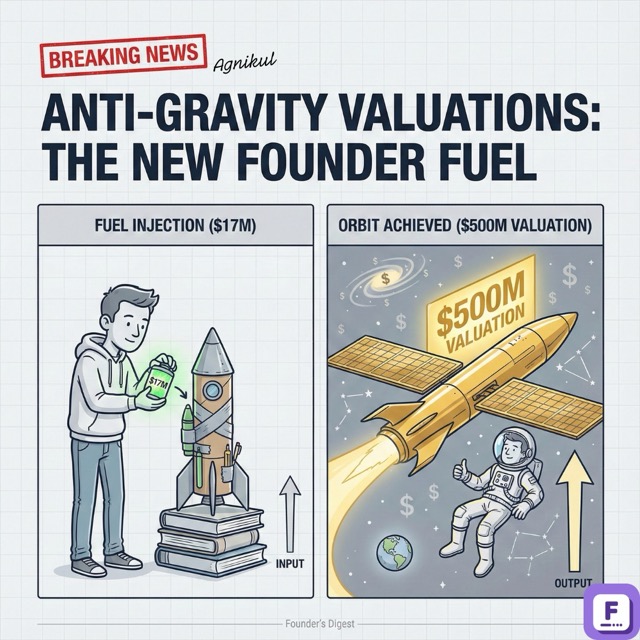
Agnikul Cosmos raised $17M (INR 150 Cr) at a $500M valuation on November 22, 2025. The round included Advenza Global, HDFC Bank, and Artha Select Fund.
This is not just a capital injection; it is a separation event. Following its successful Agnibaan SOrTeD launch in May 2024, Agnikul has moved from “R&D risk” to “execution risk.” The capital is earmarked for a 350-acre integrated space campus in Tamil Nadu to scale manufacturing, not just prototyping.
The immediate implication: The Indian launch vehicle market has formally calcified into a duopoly (Skyroot and Agnikul). For every other launch startup in India, the fundraising door just slammed shut. Investors are no longer betting on “who can fly”; they are betting on “who can scale.”
WHY IT MATTERS
- For deeptech investors: Capital concentration accelerates immediately. The “power law” in launch vehicles has kicked in; expect Series A rounds for new launch players to dry up by Q2 2026.
- For satellite operators: Domestic launch capacity doubles within 18 months. Reliance on ISRO’s PSLV or SpaceX rideshares diminishes as Agnikul and Skyroot operationalize “on-demand” launch cadences.
- For Indian space startups: The exit path narrows. Acquisition by the Big Two (Agnikul/Skyroot) becomes the primary liquidity event for propulsion and subsystem manufacturers unable to raise Series B.
BY THE NUMBERS
- Valuation: $500M post-money (Source: Inc42, Nov 2025)
- Funding Amount: $17M / INR 150 Cr (Source: Entrackr, Nov 2025)
- Payload Capacity: 100kg to 700km Low Earth Orbit (Source: Agnikul technical specs)
- Manufacturing Velocity: 3D-printed Agnilet engine produced in 72-96 hours (Source: Agnikul production data)
- Infrastructure Scale: 350-acre campus allocated by Tamil Nadu government (Source: Company Statement, Nov 2025)
- Competitor Funding: Skyroot Aerospace raised $99.8M total through 2024 (Source: Tracxn data)
- Market Growth: Global small satellite market projected to hit $8.4B by 2033 (Source: IMARC Group, 2025).
COMPETITOR LANDSCAPE
Skyroot Aerospace remains the primary domestic rival. Valued similarly and backed by Temasek and GIC, Skyroot successfully launched the Vikram-S in 2022. Their strategy mirrors SpaceX’s early Falcon 1 days—conventional materials, rapid iteration. Skyroot leads in total capital raised (~$100M+), giving them a slight runway advantage.
Globally, Rocket Lab owns this segment. With the Electron rocket, Rocket Lab (RKLB) generated $300M+ in revenue (2024 estimates) and dominates the 300kg payload class. Agnikul competes not on raw lift, but on “responsiveness.” Agnikul’s mobile launchpad (Dhanush) allows launch from almost anywhere, a capability Rocket Lab and Skyroot currently lack.
SpaceX Transporter missions are the pricing floor. At ~$5,500/kg, SpaceX is cheap but restrictive (bus-schedule timing). Agnikul targets the premium “taxi” market—operators willing to pay $20k-$30k/kg for specific orbits and timing.
INDUSTRY ANALYSIS
The Indian space sector is undergoing a “capex shift.” In 2023-2024, funding dropped 55% as the initial hype cycle cooled (Source: VCCircle, Jan 2025). The capital that remains is flowing exclusively to quality. The days of raising $5M on a PowerPoint deck and a propulsion diagram are over.
Policy tailwinds are turning into cash flow. The IN-SPACe $120M (INR 1,000 Cr) venture fund approved in late 2024 has de-risked private capital entry. Furthermore, the 100% FDI liberalization for satellite manufacturing means global capital can now pour into downstream applications.
Investor sentiment has shifted from “innovation” to “infrastructure.” Public comments from VC partners at Speciale Invest and Artha indicate a preference for companies that can service the backlog of 30,000+ satellites planned for deployment this decade. The “build a rocket” phase is finished; the “fill the rocket” phase has begun.
FOR FOUNDERS
- If you are building a launch vehicle: Pivot to subsystems within 6 months. You cannot compete with Agnikul’s $500M valuation or Skyroot’s $100M war chest. Action: Rebrand as a supplier (propulsion, avionics, separation systems) and target the Big Two as customers.
- If you are a satellite operator: Lock in launch slots for 2026-27 now. Manifests will fill rapidly as Agnikul operationalizes. Action: Sign Letters of Intent (LOI) immediately to secure pricing before commercial reliability premiums kick in.
- If you are raising Series A in spacetech: Stop selling the tech; sell the data. Investors are tired of hardware risk. Action: Show how your hardware enables data monetization (earth observation, comms) with <12 month payback periods.
FOR INVESTORS
- For growth-stage portfolios: The “SpaceX of India” winner-take-most dynamic is active. Consolidate holdings into Agnikul or Skyroot. Avoid spraying capital into third- or fourth-place launcher companies. Watch for: Successful orbital insertion by Agnikul in H1 2026 as the final validation signal.
- For new deployments: Look downstream. The value is moving from the “trucks” (rockets) to the “cargo” (satellites) and the “logistics” (ground stations/data). Action: Scout companies building on-orbit servicing (refueling/repair) or edge-computing on satellites. These sectors are where the next Agnikul will emerge in 3 years.
THE COUNTERARGUMENT
The counterargument: The addressable market for dedicated small launch is smaller than projected.
SpaceX’s Transporter missions ($5,500/kg) are ruthlessly efficient. If SpaceX increases launch cadence to weekly, the “wait time” advantage of small launchers like Agnikul evaporates. Why pay Agnikul $25,000/kg when you can wait two weeks for a $5,500/kg ride on a Falcon 9?
History supports this risk. Relativity Space abandoned its Terran 1 small rocket to build a medium-lift vehicle. Astra Space failed to find a business model and went private. Virgin Orbit went bankrupt. If Agnikul cannot drop prices below $15,000/kg while maintaining positive gross margins—a feat no small launcher has achieved at scale—they may own a large share of a non-existent market.
This view is correct if: (1) SpaceX Transporter cadence exceeds 20 missions/year, or (2) Satellite operators prove highly price-sensitive and indifferent to specific orbital parameters.
BOTTOM LINE
Agnikul’s $500M valuation closes the door on the Indian launch vehicle startup era. The market has selected its champions. For the next 24 months, value accrues to those who can manufacture at scale and those who build the payloads these rockets will carry. The hardware war is over; the data war begins.
