THE SITUATION
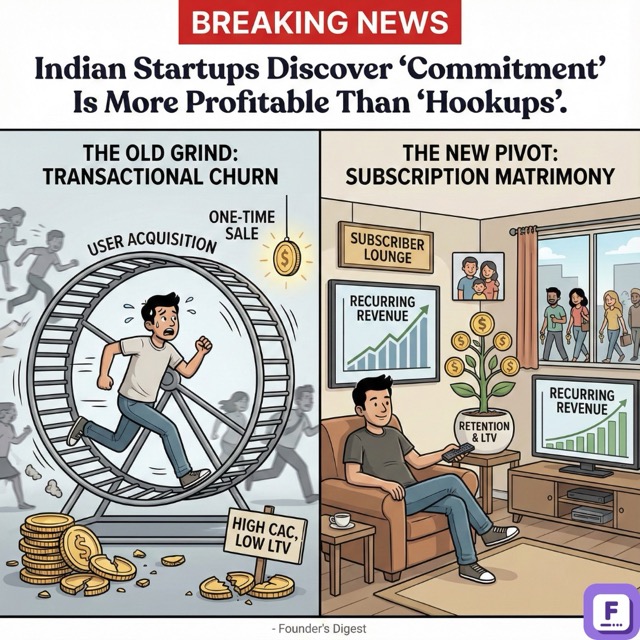
Indian New-Age tech companies have executed a synchronized pivot from “growth at all costs” to “retention at any price” in Q3 2025. The primary vehicle is no longer the transaction; it is the subscription.
Recent Q2 FY26 earnings confirm the shift. Zomato, Paytm, and PB Fintech all reported profitability surges driven by non-transactional recurring revenue streams—membership fees, device subscriptions, and renewal commissions.
This matters because it kills the “Indian users won’t pay” narrative. The market has bifurcated: discretionary apps face subscription fatigue, but utility platforms have successfully converted high-frequency usage into a tax on convenience. The “user” is now a “subscriber,” and the “platform” is now a “utility.”
WHY IT MATTERS
- For Public Market Investors: Valuation models shift immediately from GMV multiples to ARR (Annual Recurring Revenue) multiples. Companies disclosing “subscription revenue” separately will command a 20-30% premium over pure transactional peers.
- For Late-Stage Startups: The exit door narrows. IPO investors now demand a “predictability index”—revenue that shows up automatically on Day 1 of the month.
- For Competitors: The moat is no longer capital; it is lock-in. High switching costs (sunk subscription fees) make customer acquisition for new entrants 40-50% more expensive.
BY THE NUMBERS
- Paytm Device Subscriptions: 13.7 million merchants paying monthly rental as of September 2025, up 2.5 million YoY. (Source: Paytm Earnings Release, Nov 2025)
- Zomato Revenue Surge: Consolidated revenue hit ₹13,590 Cr in Q2 FY26 (+183% YoY), driven by Quick Commerce and membership frequency. (Source: Univest, Oct 2025)
- PB Fintech Renewal ARR: Trail revenue reached ₹774 Cr (+39% YoY), operating at >85% margins. (Source: Mint, Oct 2025)
- Subscription Fatigue: 40% of consumers cancelled at least one subscription in 2024, signaling a flight to quality. (Source: International Finance, Nov 2025)
- Ola Driver Subscription: Shifted to a ₹67/day fixed subscription for drivers, abandoning the % commission model. (Source: Trak.in, Oct 2025)
CONTEXT
The transition began in 2023-2024 as funding dried up. Zomato launched Gold (re-launched) not just for loyalty, but to subsidize the transition to Blinkit (Quick Commerce), creating a cross-platform lock-in.
Paytm pivoted from a “marketing spend” wallet model to a “SaaS” soundbox model in 2022-2023. By late 2025, this device network became their primary defense against UPI zero-MDR (Merchant Discount Rate) regulations, effectively turning a payments company into a hardware-subscription business.
PB Fintech (Policybazaar) played the long game. While originally valued on new policy sales, the company spent five years building a renewal book. By Q2 FY26, this “unpaid” revenue stream became the primary driver of their ₹135 Cr quarterly profit, validating the insurance-as-a-subscription thesis.
COMPETITOR LANDSCAPE
The Ecosystem Lock-in War Zomato (Gold) vs. Swiggy (One) is no longer about food delivery; it is about share of wallet. Zomato Gold members order 40% more frequently, effectively subsidizing the low-margin food business with high-margin Quick Commerce volume.
The Premium Tier Battle Flipkart entered the fray with “Flipkart Black” (₹1,499/year) and “VIP” (₹799/year) in late 2025, bundling YouTube Premium to combat Amazon Prime’s entertainment dominance. This signals that commerce alone is insufficient for retention; content is the necessary loss leader.
The Supply-Side Pivot Ola and Namma Yatri disrupted Uber’s commission model by moving drivers to a daily subscription (SaaS for drivers). This forces competitors to either lower commissions (hurting take rates) or adopt the subscription model (risking revenue volatility).
INDUSTRY ANALYSIS
The Indian market has matured from “Access” (2015-2020) to “Convenience” (2021-2024) to “Habit” (2025+).
The Shift: CAC (Customer Acquisition Cost) has become unsustainable for transactional models. Companies are trading lower margins on individual transactions for the predictability of recurring revenue. This is visible in the “Platform Fee” normalization—consumers complained in 2024 but accepted it by 2025 as the cost of instant gratification.
Public Sentiment: Investors have stopped rewarding “User Growth” and started rewarding “Net Revenue Retention” (NRR). Earnings calls in Q3 2025 were dominated by metrics like “renewal rates,” “device penetration,” and “membership contribution to GMV.”
Capital Flows: Venture capital is concentrating on “Vertical SaaS” and “Consumer Utility” models. Pure-play transactional marketplaces are seeing Series B/C valuations compress 40% unless they have a clear recurring revenue roadmap.
FOR FOUNDERS
- If you’re a B2C Transactional App: You are bleeding value if you don’t have a lock-in. Launch a membership tier within 90 days. It doesn’t need to be profitable; it needs to increase frequency by 1.5x to amortize CAC.
- If you’re pitching Series A/B: Stop highlighting GMV. Start highlighting NRR (Net Revenue Retention). Investors in late 2025 are pricing companies based on the % of revenue that shows up automatically.
- If you’re in Logistics/Gig Economy: Copy the Ola model. Move supply-side partners to a subscription model (SaaS fee) rather than a tax on their labor (commission). It aligns incentives and stabilizes supply.
FOR INVESTORS
- For Public Market Portfolios: Overweight companies with >30% revenue from recurring sources (Paytm, PB Fintech). Underweight pure transactional plays that are fighting the “lowest price” war. The former has pricing power; the latter has margin compression.
- For Early Stage Deal Flow: Scrutinize the “Subscription” slide. Is it a utility (Soundbox/Storage) or discretionary (Content/Curated Box)? In a high-inflation environment (subscription fatigue), discretionary subs are the first to be cancelled. Back Utility.
- Signal to Watch: “Platform Fees” increasing. If a company raises platform fees without losing volume, they have achieved utility status. This is the strongest buy signal in the current Indian market.
THE COUNTERARGUMENT
The counterargument: This pivot is a temporary inflation of LTV (Lifetime Value) that masks a shrinking TAM (Total Addressable Market).
India remains a value-conscious market. The “Subscription Class” is likely capped at the top 50-80 million users (India 1). Beyond this layer, the masses may reject recurring costs, preferring ad-supported or pay-per-use models. If ONDC (Open Network for Digital Commerce) successfully unbundles these services—allowing users to buy Zomato food with Dunzo delivery—the subscription “moat” collapses.
This view would be correct if: (1) ONDC achieves >15% market share in food/grocery by 2026, or (2) Subscription churn rates spike >5% monthly in Q1 2026, indicating the ceiling has been hit.
BOTTOM LINE
The “Growth” era of Indian tech is dead; the “Retention” era has begun. Companies that successfully tax habit (subscription) will survive the 2026 consolidation. Companies relying on the next transaction to pay this month’s bills will be acquired or liquidated. The window to build a recurring revenue engine is closing.
