THE SITUATION
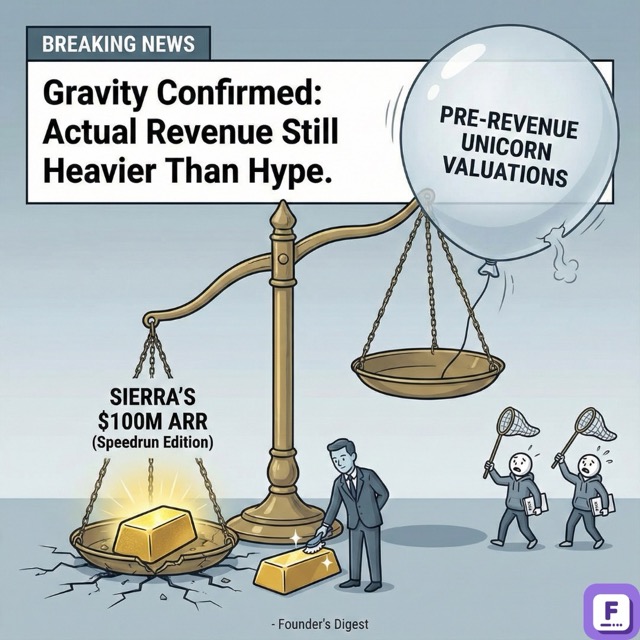
Sierra, the enterprise AI agent startup co-founded by Bret Taylor and Clay Bavor, hit $100 million in annual recurring revenue (ARR) on November 21, 2025. The milestone arrived just 21 months after launch, making Sierra one of the fastest companies in history to reach nine-figure revenue.
The valuation matches the velocity. Sierra raised $350 million in September 2025 at a $10 billion valuation, led by Greenoaks Capital. This implies a 100x forward revenue multiple, shattering the 10-15x standard for top-tier SaaS.
The primary driver is a structural shift in pricing. Unlike legacy SaaS vendors charging per seat, Sierra charges per successful resolution. Customers like SoFi, Ramp, and ADT pay only when the AI completes work, effectively hiring digital labor rather than renting software.
This forces a market-wide reckoning. Incumbent SaaS vendors (Salesforce, Zendesk) dependent on seat expansion now face a competitor that monetizes result, not headcount.
WHY IT MATTERS
- For Enterprise SaaS Incumbents: The seat-based model expires in 12-18 months. Customers will refuse to pay for “tools for humans” when competitors offer “replacement for humans” priced on outcomes.
- For Series B/C AI Startups: Traction standards just reset. Investors now benchmark “breakout” velocity against Sierra’s 21-month sprint to $100M, making $10M ARR in Year 3 look like stagnation.
- For Enterprise Buyers: Procurement leverage shifts immediately. Buyers can now demand outcome-based SLAs from all AI vendors, rejecting “copilot” pricing that charges for software without guaranteeing results.
- For Customer Experience Leaders: Labor arbitrage returns home. Replacing offshore BPOs with onshore AI agents becomes cheaper and higher quality, reversing a 20-year outsourcing trend by 2026.
BY THE NUMBERS
- ARR Milestone: $100M in November 2025, up 5x from $20M in late 2024 (Source: TechCrunch, Nov 2025)
- Time to $100M: 21 months from launch, faster than Slack, Zoom, or Salesforce (Source: FindArticles, Nov 2025)
- Valuation: $10B post-money as of September 2025 (Source: PitchBook, Sep 2025)
- Valuation Multiple: ~100x ARR (Source: FindArticles, Nov 2025)
- Total Funding: $635M across Seed, Series A, and Series B (Source: Tracxn, Sep 2025)
- Customer Base: Includes SoFi, Ramp, Brex, Sonos, WeightWatchers, and ADT (Source: Sierra Press Release, Nov 2025)
- Pricing Model: Outcome-based (pay-per-resolution) vs. traditional subscription (Source: Sacra, Oct 2024)
COMPETITOR LANDSCAPE
Salesforce (Agentforce) represents the primary incumbent threat. Launched in late 2024, Agentforce attempts to pivot Salesforce’s massive installed base from seats to consumption credits ($2 per conversation). Salesforce has distribution dominance but struggles with the Innovator’s Dilemma—cannibalizing its own seat revenue.
Decagon and Intercom (Fin) compete for the “AI-native” support budget. Intercom focuses on SMB/Mid-market with a low-friction setup, while Decagon targets enterprise support automation. Sierra differentiates through “brand-specific” guardrails and high-touch customization, justifying a premium price point.
Internal Development remains a silent competitor. Tech-forward companies like Klarna replaced 700 agents with internal OpenAI-wrapper tools. Sierra counters this by selling “trust and compliance” that internal engineering teams struggle to certify for regulated industries like finance (SoFi, Brex).
INDUSTRY ANALYSIS
The market is shifting from “software assistance” to “digital labor.” In 2023-2024, companies bought Copilots to make humans 30% faster. In 2025, they are buying Agents to replace the human entirely for Tier 1 and Tier 2 tasks.
Public sentiment confirms this transition. On earnings calls, CEOs now highlight “resolution rates” rather than “agent efficiency.” Bret Taylor explicitly positions Sierra as “hiring work” rather than “buying software,” noting that enterprises budget for outcomes differently than for tools.
Capital flows follow the labor narrative. While SaaS funding cooled in 2024, funding for “Agentic AI” surged. Investors recognize that the Total Addressable Market (TAM) for labor ($2T+ for customer service wages) dwarfs the TAM for software ($600B). Sierra’s $10B valuation prices in this TAM expansion.
FOR FOUNDERS
- If you’re building B2B AI apps: Pivot to outcome-based pricing before Q1 2026. Customers will stop paying for subscriptions that don’t guarantee work. Action: Audit your product—can you measure a “completed unit of work”? If not, you are a tool, not an agent, and your pricing power is zero.
- If you’re selling to Enterprise: Trust is your only moat against incumbents. Sierra won because they sold “safe” AI, not just “smart” AI. Action: Invest 50% of engineering resources into guardrails and auditability logs within 90 days, or lose the procurement war to Salesforce.
- If you’re raising capital: Revenue quality now matters more than quantity. Sierra used specific revenue metrics to recruit talent and court investors. Action: Report “work automated” metrics (e.g., “1M tickets resolved”) alongside ARR to prove your revenue is durable, not experimental.
FOR INVESTORS
- For SaaS portfolios: The “seat expansion” growth thesis is dead. Companies relying on headcount growth for upsells face contraction as customers deploy agents like Sierra. Action: Short/Divest from legacy helpdesk tools that lack a credible consumption-pricing pivot strategy by H1 2026.
- For new AI investments: Screen for “services-as-software.” The winners will look like tech-enabled BPOs (high ACV, outcome pricing) rather than traditional SaaS. Signal to watch: Does the startup charge for the software or the result? Fund the result.
- For valuation models: Ignore the 100x multiple—it’s an outlier. Sierra gets a “Taylor Premium” and a “category creator” premium. Action: Do not underwrite other Series B startups at >50x ARR expecting a Sierra-like exit. The market cannot support multiple $10B agents in the same vertical.
THE COUNTERARGUMENT
The counterargument: Sierra is a consulting firm valued like a software company.
The “high-touch implementation” required to map enterprise workflows suggests low gross margins disguised as high-growth SaaS. If Sierra relies on deployed engineers to configure agents for each client (SoFi, ADT), their margins will resemble Accenture (15-30%) rather than Adobe (85%). A $10B valuation for a services business is unsustainable.
Furthermore, the “moat” may be temporary. As LLMs get smarter and cheaper (GPT-5, Claude 4), the “guardrails” Sierra sells might become native features of the underlying models. If OpenAI or Anthropic solves reliability at the model layer, Sierra’s value proposition evaporates, turning them into a thin wrapper over a commodity API.
This view would be correct if: (1) Sierra’s gross margins remain below 60% in 2026, or (2) Salesforce Agentforce achieves parity in resolution rates without the high implementation cost.
BOTTOM LINE
Sierra’s $100M ARR milestone marks the official death of seat-based pricing for enterprise AI. The market has validated that companies will pay premiums for completed work, not just software tools. Founders must price for outcomes or perish; investors must fund labor replacement, not productivity enhancement. The era of “copilots” is over.
