THE SITUATION
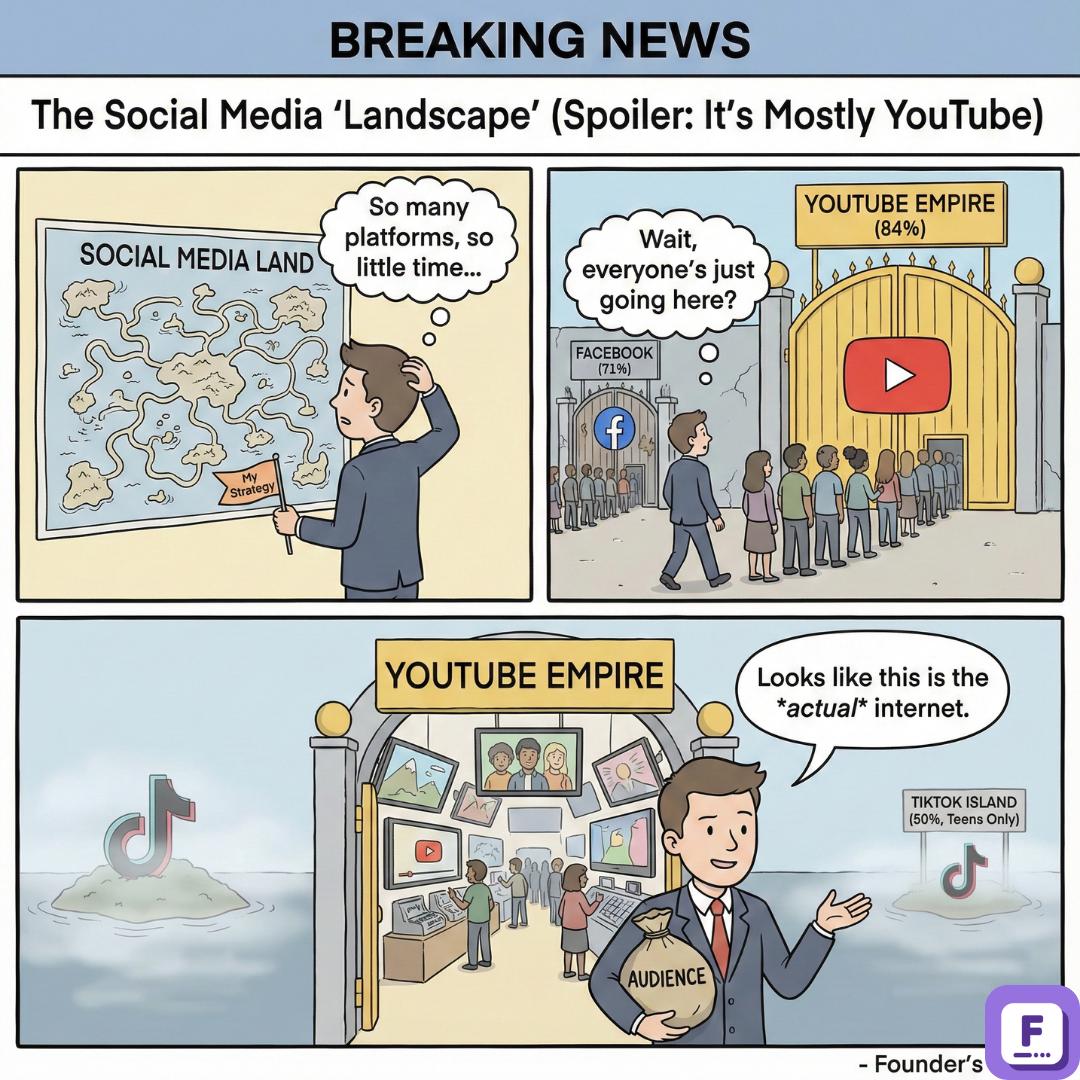
The “social media” era has effectively ended; the “algorithmic media” era has begun. Pew Research Center data released late 2024 confirms YouTube’s absolute dominance, reaching 84% of all U.S. adults and 93% of teens. While Facebook remains a utility for 71% of adults, its relevance with younger demographics has collapsed—only 20% of teens use it daily.
The numbers expose a bifurcated reality: YouTube wins the living room (52% of viewership is now on TV screens) while TikTok wins mobile attention (53.8 minutes/day average). This isn’t fragmentation; it’s a consolidation of power into two video-first giants, with Meta’s Instagram holding the middle ground.
The direct impact: Advertising budgets are decoupling from “social graphs” (who you know) and locking into “interest graphs” (what you watch). The $355 billion video marketing industry is shifting capital to platforms that act like television, not town squares.
WHY IT MATTERS
- For brand advertisers: Spend efficiency drops on static platforms. Capital must reallocate to Connected TV (YouTube) and short-form video (TikTok/Reels) where 72% of consumers now prefer to discover products.
- For consumer founders: The “viral social app” investment thesis is dead. New entrants cannot compete with the network effects of YouTube (2.7B users) or the algorithmic velocity of TikTok without a specific vertical wedge.
- For legacy media: YouTube is no longer a partner; it is the primary replacement for linear TV. With 850M+ unique viewers watching on TV screens, YouTube has effectively become the world’s largest cable provider without the infrastructure costs.
BY THE NUMBERS
- YouTube Ad Revenue: $8.92B in Q3 2024, up 12.2% YoY (Source: Alphabet Earnings Q3 2024)
- Meta Revenue: $40.6B in Q3 2024, up 19% YoY, driven by AI-improved ad targeting (Source: Meta Earnings Q3 2024)
- TikTok Global Revenue: ~$23B in 2024 (ads), with total video-related revenue reaching ~$63B when including in-app spend (Source: Omdia/Business of Apps)
- Teen Daily Usage: YouTube (73%), TikTok (58%), Instagram (50%), Facebook (20%) (Source: Pew Research Center, 2024)
- Video Market Value: Global video marketing industry valued at ~$355B (Source: Valueleaf, 2024)
- Engagement Gap: TikTok average daily use is 53.8 minutes vs. YouTube’s 48.7 minutes on mobile (Source: DemandSage, 2024)
COMPETITOR LANDSCAPE
The Tier 1 Video Duopoly (YouTube & TikTok):
YouTube owns long-form and the TV screen. Its creator payouts ($70B+ historically) create a “middle class” of media businesses that lock in supply. TikTok owns culture and immediate trends but faces monetization friction—creators struggle to convert views to dollars compared to YouTube’s AdSense.
The Utility Layer (Meta):
Facebook and Instagram are no longer entertainment primary; they are digital directories and commerce engines. Meta’s advantage is ad performance—Q3 ad prices increased 11% because their conversion data is superior, even if their content is less engaging than TikTok’s.
The Niche Leftovers:
X (Twitter), Snapchat, and Pinterest have been relegated to specific utilities (news, close friends, visual search). They cannot compete for broad brand awareness budgets, fighting instead for performance scraps.
INDUSTRY ANALYSIS
The market has shifted from connection to consumption.
In 2015, the value prop was “connect with friends.” In 2025, it is “entertain me immediately.” This structural shift favors algorithmic discovery over follower feeds.
Sentiment tracks the money: Advertiser surveys show Connected TV (CTV) and social video are the only “must buys” for 2025. CMOs are openly deprioritizing static display ads. The sentiment on earnings calls is clear: Alphabet and Meta are highlighting AI-driven recommendations as the primary revenue driver, effectively admitting that human curation is obsolete.
Capital Flows:
Venture capital has largely abandoned generalist social media. Funding is moving into vertical communities (e.g., Strava for fitness, gaming platforms) or AI-native content generation tools. The “next Facebook” will not be a social network; it will be an AI agent or a game.
FOR FOUNDERS
- If you are building a consumer app: Do not build a “social graph.” Build an “interest graph” from day one. Users will not manually curate friends in 2025; they expect algorithms to curate content.
- Action: Focus on SEO and algorithmic discovery (YouTube/TikTok) for distribution, not viral invites.
- If you are a B2B founder: Your content strategy is likely obsolete. Blog posts no longer convert like video.
- Action: Pivot content marketing budget to video serialization (YouTube) and short-form clips (LinkedIn/Shorts) by Q2 2025.
- If you rely on paid acquisition: Facebook ads are getting more expensive (+11% pricing).
- Action: Diversify into YouTube Shorts ads and TikTok ads immediately to arbitrage lower CPMs before they normalize in 12 months.
FOR INVESTORS
- For public equity portfolios: Long Alphabet and Meta. They are the only two companies with the compute power and data volume to power the AI recommendation engines that define modern media.
- Signal: Watch YouTube’s CTV ad revenue growth—if it stays above 10%, they are successfully eating linear TV’s lunch.
- For venture portfolios: Scrutinize any “social” investment that relies on user-generated network effects. The barrier to entry for a new network is now impossibly high due to entrenched attention habits.
- Action: Pivot focus to tools that enable creators on YouTube/TikTok rather than platforms trying to replace them.
- For media investments: The “pivot to video” is real this time, but it’s algorithmic.
- Thesis: Content libraries that can be sliced into “Shorts” are undervalued assets.
THE COUNTERARGUMENT
The Counterargument: TikTok’s dominance may be fragile due to regulatory headwinds and monetization inefficiency.
If the U.S. proceeds with a ban or forced sale, 135M+ users would be displaced. Furthermore, if TikTok cannot solve its creator monetization problem (creators earn significantly less per view than on YouTube), the “talent drain” could revert usage back to YouTube Shorts and Instagram Reels.
This would be correct if: (1) A U.S. ban is enacted and enforced in 2025, or (2) Top tier creators publicly abandon TikTok for YouTube due to pay disparities. Currently, creators use TikTok for reach and YouTube for revenue—a stable equilibrium.
BOTTOM LINE
The social internet is over. We have entered the age of algorithmic television.
YouTube has won the war for attention infrastructure, while Meta has won the war for advertising utility. Founders and investors must stop treating these platforms as “social networks” and start treating them as the new global broadcast standard. If you aren’t building for video, you are invisible.
