THE SITUATION
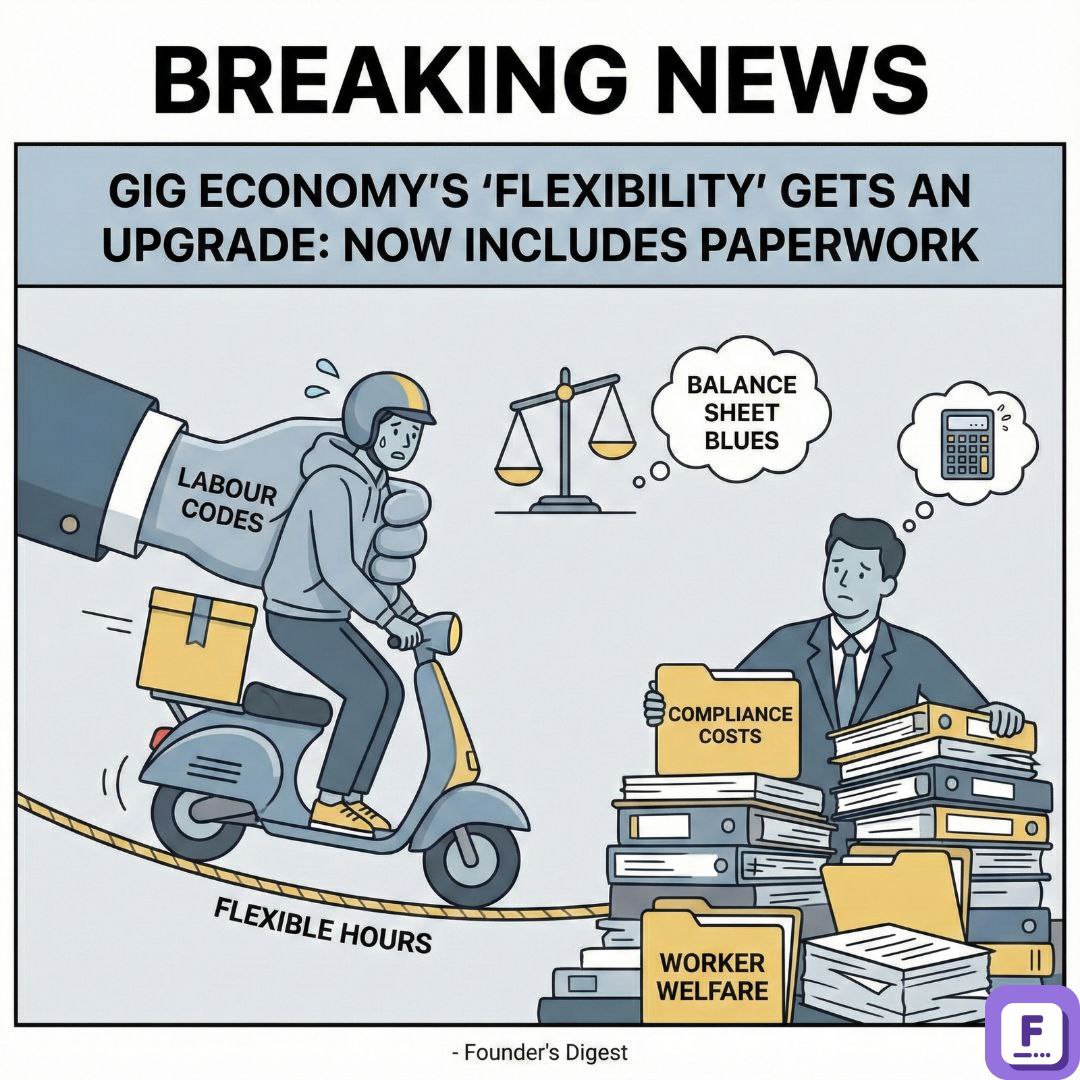
The Indian government notified four consolidated labour codes effective November 21, 2025, ending years of regulatory ambiguity for the gig economy. The Code on Social Security, 2020, explicitly recognizes “gig workers” and “platform workers” for the first time, mandating a social security net funded by aggregators.
The core financial mechanism is set: Aggregators must contribute 1-2% of their annual turnover to a social security fund, capped at 5% of the amount paid to workers. This applies immediately to ride-hailing (Uber, Ola), food delivery (Zomato, Swiggy), and quick commerce (Blinkit, Zepto, Swiggy Instamart).
This changes the unit economics of the Indian internet economy overnight. Platforms that built business models on “partner” labor arbitrage now face a non-negotiable statutory cost that directly hits EBITDA.
WHY IT MATTERS
- For Platform Aggregators: Gross margins compress by 100-200 basis points immediately. Companies must either absorb this (delaying profitability) or pass it to consumers (risking volume growth in a price-sensitive market).
- For Gig Workers: 7.7M+ workers gain portable social security benefits (health, maternity, disability) via an Aadhaar-linked Universal Account Number (UAN), decoupling welfare from single-employer dependence.
- For Venture Investors: Valuation models based on 2023-2024 unit economics are obsolete. The “burn to grow” model becomes 2% more expensive, and the path to free cash flow narrows.
BY THE NUMBERS
- Mandatory contribution: 1-2% of annual turnover (Source: Ministry of Labour & Employment Notification, Nov 2025)
- Contribution cap: 5% of total amount paid to gig workers (Source: Code on Social Security, 2020)
- Affected workforce: 7.7M workers in 2021, projected to hit 23.5M by 2029-30 (Source: NITI Aayog Report)
- Zomato/Swiggy combined impact: Estimated $50M-$70M annual EBITDA hit at current run rates (Source: Analyst estimates based on FY25 revenue)
- Compliance deadline: Immediate effect from notification date (Source: Government Gazette)
COMPANY CONTEXT
Zomato and Swiggy have spent the last decade fighting a war of attrition to prove the viability of food delivery in India. Zomato turned profitable (on a quarterly basis) only recently, driven by higher platform fees and ad revenue. Swiggy listed publicly in late 2024/early 2025 with a narrative of improving take rates.
Both companies aggressively pivoted to Quick Commerce (Blinkit and Instamart) to subsidize lower-margin food delivery. These high-growth verticals are labor-intensive. The new code hits the entire stack—delivery riders, warehouse pickers, and flex-drivers. Unlike the US (Prop 22 battle), Indian aggregators accepted the inevitability of regulation but lobbied hard to cap the contribution. The 1-2% turnover levy is the compromise: it’s a tax on revenue, not a reclassification of workers as full-time employees (which would have cost 20-30%).
COMPETITOR LANDSCAPE
The regulation favors incumbents with deep balance sheets.
Zomato & Swiggy (The Duopoly): Both have the volume to negotiate “welfare surcharges” with consumers. A ₹2-3 fee per order covers the 1% levy. Their challenge is operationalizing the data flow for millions of transient workers.
Uber & Ola: Ride-hailing is more price-elastic. Adding a surcharge risks pushing commuters back to public transport or auto-rickshaws (which often bypass the app). Uber’s margins in India are already thin; this pushes break-even further out.
Zepto & Emerging Players: This hurts challengers most. Zepto, burning cash to capture market share, now has a higher burn floor. The 1% turnover tax applies regardless of profitability. This acts as a regulatory moat, making it harder for new entrants to subsidize their way into the market.
INDUSTRY ANALYSIS
The era of “regulatory arbitrage” in India is over. The government signaled this shift with the NITI Aayog report in 2022, and now it’s law. The narrative has moved from “creating jobs at any cost” to “formalizing the informal workforce.”
Public sentiment favors the move. Frequent strikes by delivery partners in metro cities over declining incentives created political pressure. On investor calls, management teams will spin this as “clarity” and “sustainability,” but the math is brutal: 1% of turnover is a massive chunk of the bottom line for businesses with single-digit take rates.
Capital flows will bifurcate. Late-stage money will stick to leaders (Zomato/Swiggy) who can pass costs on. Early-stage funding for labor-heavy B2C models will dry up, as the “cheap labor” advantage erodes. Investors will rotate toward B2B logistics and SaaS platforms that help these companies manage compliance (the “shovels” in this gold rush).
FOR FOUNDERS
- If you run a gig-labor platform: Audit your unit economics immediately. If your gross margin before marketing is <15%, this 1-2% revenue tax makes your model unviable.
- Action: Raise platform fees or introduce a “welfare surcharge” to consumers within 30 days. Do not try to absorb this.
- If you are building HR-tech/Compliance SaaS: The market just opened. Aggregators need APIs to track worker payouts across platforms for the social security fund.
- Action: Pivot your pitch to “automated UAN compliance for gig platforms.”
- If you are raising Series A/B: VCs will deduct this tax from your GMV projections.
- Action: Show a clear path to “post-regulatory” unit economics in your deck. “We’ll figure it out at scale” is no longer an acceptable answer.
FOR INVESTORS
- For Public Market Investors (Zomato/Swiggy): Expect a short-term stock correction as analysts factor in the EBITDA hit.
- Action: Buy the dip if the company announces a clear pass-through mechanism (e.g., a consumer fee). The structural moat remains intact.
- Watch: Consumer drop-off rates in Q1 2026 after fees are hiked.
- For Early-Stage VCs: The “Uber for X” model is dead in India unless the basket size is high (>₹1000).
- Action: Stop funding low-AOV, high-labor models. Shift focus to asset-light B2B platforms or robotics/automation that reduce dependence on human labor.
- Signal: Watch for consolidation. Smaller quick-commerce players will run out of cash faster due to increased burn.
THE COUNTERARGUMENT
The counterargument: The 1-2% levy might actually improve platform efficiency and retention, offsetting the cost.
If portable social security reduces churn (currently 20-30% monthly in gig work), platforms save massive amounts on acquisition and training. A stable fleet means better service levels and higher order frequency. Furthermore, since the levy is on turnover, aggressive accounting might allow companies to define turnover strictly (net revenue vs. GMV), minimizing the cash outflow.
This would be correct if: (1) Worker retention improves by >15% within 12 months, or (2) The government allows “net revenue” definitions that exclude pass-through driver payments.
BOTTOM LINE
The “free ride” on Indian labor is over. The 1-2% levy is a permanent feature of the P&L, not a bug.
Incumbents like Zomato and Swiggy will pass this cost to consumers and survive; sub-scale players will suffocate under the added burn.
This is a consolidation event masked as a welfare reform.
