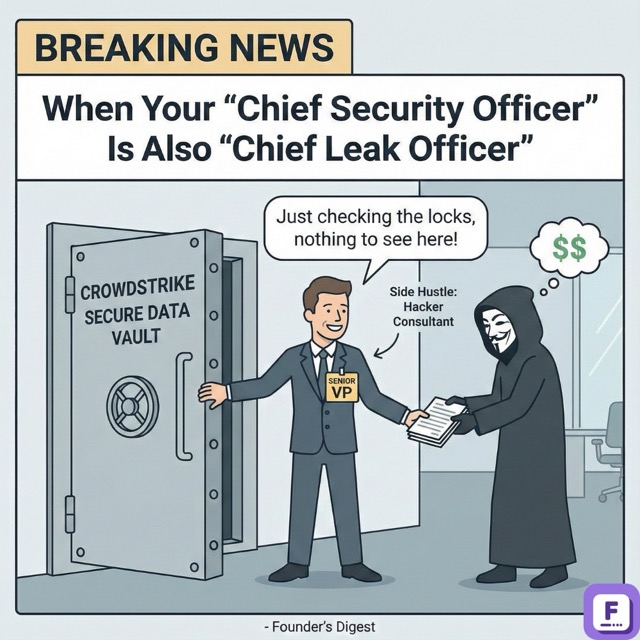
THE SITUATION
CrowdStrike terminated a senior employee suspected of leaking sensitive internal dashboards to the “Scattered Lapsus$ Hunters” hacking collective. The leak, exposed via Telegram screenshots of Okta authentication portals, triggered an immediate internal investigation and law enforcement referral.
While CrowdStrike maintains that customer data remained secure and systems were not breached, the optical damage is severe. This incident lands just months after the July 2024 faulty update outage that cost Fortune 500 clients billions. The narrative shifts from “technical reliability” to “internal integrity.”
For enterprise buyers, the implication is immediate: vendor trust is no longer a valid security strategy. Procurement teams are now freezing renewals to demand deeper personnel vetting audits, slowing sales velocity across the entire endpoint detection and response (EDR) market.
WHY IT MATTERS
- For enterprise CISOs: Vendor risk management protocols reset immediately—expect to mandate quarterly insider threat audits for all critical infrastructure providers, not just annual SOC 2 reviews.
- For security vendors: Sales cycles extend 20-30% as procurement committees add “personnel reliability” hurdles to the technical review process.
- For CrowdStrike competitors: SentinelOne and Palo Alto Networks gain temporary leverage to displace incumbents by highlighting “clean” operational records during renewal negotiations.
BY THE NUMBERS
- CrowdStrike Revenue: $3.06B projected for fiscal 2024 (Source: Company Filings)
- July 2024 Outage Cost: ~$60M in direct company expenses, plus billions in customer losses (Source: BankInfoSecurity, 2025)
- Workforce Reduction: 5% (500 employees) cut recently citing “AI efficiencies,” separate from this firing (Source: The Hindu, May 2025)
- Insider Threat Cost: Average annualized cost to large organizations is $16.2M (Source: Ponemon Institute, 2023)
- Stock Reaction: Shares dropped ~4% following recent operational updates (Source: Reuters, May 2025)
- Hacker Bounty: ShinyHunters group allegedly offered $25,000 to the insider for access (Source: BleepingComputer, Nov 2025)
COMPETITOR LANDSCAPE
SentinelOne ($8B+ market cap) positions its “Singularity” platform as the automated, lower-touch alternative. They are aggressively targeting dissatisfaction among CrowdStrike’s enterprise base, using the July outage and this insider leak to argue for vendor diversification.
Palo Alto Networks (Cortex XDR) leverages its network security dominance to bundle endpoint protection. Their strategy focuses on “platform consolidation”—arguing that fewer vendors mean fewer gaps, though this insider incident weakens the consolidation argument for any single vendor.
Microsoft (Defender) remains the default fallback. While they were the platform crashed by CrowdStrike in July, their “good enough” integrated security becomes attractive when premium vendors introduce new risks.
INDUSTRY ANALYSIS
The “Zero Trust” marketing slogan is colliding with operational reality. For years, vendors sold software to police internal users, but the vendors themselves remained opaque black boxes. That era ends now.
Public sentiment has shifted from admiration to skepticism. Following the July outage, customers realized their dependency on CrowdStrike was a single point of failure. This insider incident confirms that the risk is human, not just code. Security leaders on LinkedIn are already discussing “vendor diversity” strategies—running different EDR agents on servers vs. workstations to mitigate vendor-specific risks.
Capital flows reflect this fragmentation. Investors are cooling on “platform consolidation” plays and looking at “vendor risk management” and “insider threat detection” startups. The thesis is shifting from “who stops the hackers?” to “who watches the watchmen?”
FOR FOUNDERS
- If you’re building insider threat detection: Your market just tripled. Pitch your solution not just for employees, but for monitoring third-party vendors. Action: Update your deck to explicitly reference “supply chain human risk” before your next partner meeting.
- If you’re a security startup CEO: Your background check process is now a sales asset. Publish your vetting standards transparency report by Q1 2026. Buyers need proof you aren’t hiring the next leak.
- If you’re selling enterprise SaaS: Expect “personnel security” addendums in your next master services agreement (MSA). Audit your access controls this week—if a junior dev has admin access to production, you will fail procurement.
FOR INVESTORS
- For growth-stage security portfolios: The “Trust Premium” is gone. Companies with <110% net revenue retention (NRR) will face churn as customers diversify vendors. Action: Stress-test portfolio companies on their dependency on single-vendor contracts.
- For new investments in cybersecurity: Look for “Vendor Vetting as a Service” (VVaaS). The manual process of auditing vendor employee security is unscalable; automation here is the next unicorn category.
- For public market exposure: Short-term volatility in CrowdStrike (CRWD) creates an entry point, but only if you believe the stickiness of EDR prevents rip-and-replace. The switching costs are high, but the leverage has shifted to the buyer.
THE COUNTERARGUMENT
The counterargument: This incident actually proves CrowdStrike’s security works.
The company identified the insider, terminated them, and prevented a full breach before customer data was exfiltrated. The system functioned exactly as designed. Insider threats are a statistical inevitability for any company with thousands of employees; catching one quickly is a signal of strength, not weakness.
This view holds if: (1) No customer data leaks appear on dark web forums in the next 90 days, confirming the containment; and (2) CrowdStrike transparently releases a post-mortem detailing how they caught the actor, turning the incident into a case study for their own identity protection products. If they control the narrative, they validate their platform.
BOTTOM LINE
CrowdStrike’s insider leak ends the era of blind vendor trust. Enterprise buyers will enforce punishing audit cycles for the next 12 months, slowing deal velocity across the security sector. The winners won’t be the vendors with the best AI, but the ones who can prove their own house isn’t burning.
