THE SITUATION
Google’s “ten blue links” monopoly on user attention officially broke in Q3 2025. Advanced Web Ranking’s latest report (released November 21, 2025) reveals a structural shift in how users interact with search results: the “Fan Out” effect.
For branded desktop searches, the #1 organic position is no longer the default destination. Position 1 Click-Through Rate (CTR) dropped 1.52 percentage points, while Positions 2 through 6 gained a combined 8.71 points. Users are scrolling past the top result to find specific sub-pages or third-party reviews.
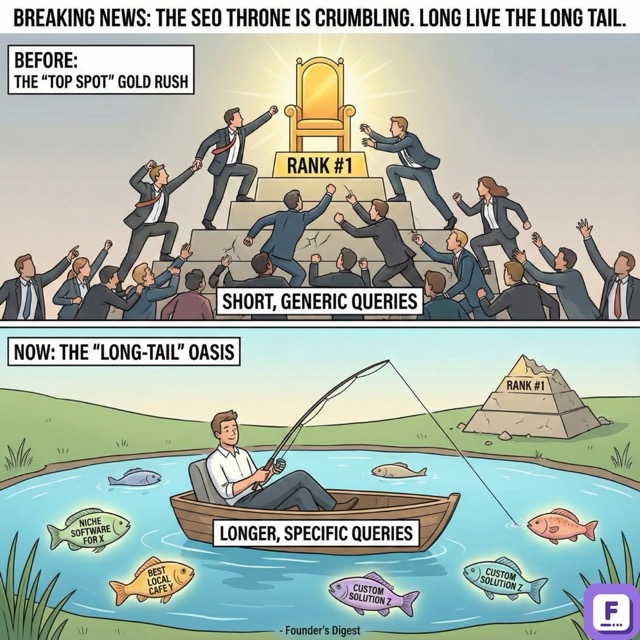
Simultaneously, commercial intent is being squeezed. For “buy” or “price” queries, the top two organic spots lost 4.20 percentage points in click share. The only safe harbor is complexity: queries with 4+ words (long-tail) remained the only category with stable CTRs.
WHY IT MATTERS
- For Brand Owners (DTC & SaaS): Your “navigational” traffic is bleeding. Competitors and affiliates ranking in positions 2-6 are capturing nearly 9% more of your branded search volume than in Q2.
- For E-commerce Operators: High-intent generic keywords (“buy running shoes”) are now effectively pay-to-play. With organic top-spot CTRs down 3%, organic customer acquisition costs (CAC) on commercial terms will rise as volume creates a vacuum.
- For Content Publishers: The “short-tail” is dead. Content targeting 1-3 word queries faces high volatility and AI cannibalization; only deep-dive, 4+ word problem-solving content offers predictable traffic.
BY THE NUMBERS
- Branded Position 1 Drop: -1.52 percentage points on desktop in Q3 2025.
- Branded Mid-Tier Gain: Positions 2-6 gained a combined +8.71 percentage points.
- AI Overview Impact: Organic CTR plummets to 0.64% when an AI Overview is present, vs 3.97% without (Jan 2025 baseline).
- Citation Value: Being cited in an AI Overview boosts organic CTR by 35% (from 0.52% to 0.70%).
- Mobile Divergence: Unlike desktop, 1-word mobile queries saw Position 1 CTR increase by 1.52 points.
- Commercial Squeeze: Top 2 positions for commercial queries lost 4.20 CTR points on desktop.
- Answer Engine Growth: Referral traffic from ChatGPT is up 44% and Perplexity up 71% in 2025.
COMPANY CONTEXT
Google has systematically transitioned from a search engine (sending traffic away) to an answer engine (keeping traffic on-site) throughout 2024 and 2025. The introduction of AI Overviews (formerly SGE) accelerated this, creating a “Zero Click” environment where 60%+ of searches result in no referral.
This shift is defensive. With ad revenue under pressure from Amazon (commercial search) and TikTok (discovery), Google has increased the ad load above the fold. The Q3 2025 introduction of “Nano Banana Pro” in AI Mode and new ad formats within AI results confirms that monetization is now competing directly with organic visibility for pixel space. The “Fan Out” data suggests users are adapting to this clutter by scrolling deeper to find organic links, bypassing the ad-heavy top-of-page.
COMPETITOR LANDSCAPE
The competition is no longer just other websites ranking for keywords; it is the “Answer Engines” that intercept intent before it reaches a browser.
- Perplexity & ChatGPT: These platforms are becoming primary destinations for informational queries. Referral traffic from Perplexity grew 71% in 2025. They monetize via subscriptions, allowing cleaner interfaces that steal high-value “research” users from Google.
- Vertical Search (Amazon/TikTok): Commercial queries are migrating. The drop in Google’s commercial CTR (-4.20 points) reflects users checking Google for research but converting elsewhere, or Google forcing paid placements to capture the remaining value.
- Social Search: Younger demographics treat TikTok/Instagram as search engines. Google’s response—integrating forum results and “Hidden Gems”—has fragmented the SERP, contributing to the decline of the singular “Position 1” authority.
INDUSTRY ANALYSIS
The SEO industry is undergoing a forced pivot from “ranking” to “visibility.” The Q3 data confirms that the “Winner Take All” dynamic of SEO (where Position 1 took 30%+ of clicks) is eroding.
Sentiment among operators has shifted from optimization to panic regarding “Zero Click” searches. With organic CTRs for AI-covered queries dropping to 0.64%, the traditional traffic funnel is broken. Agencies are reorienting toward “Digital PR”—getting brands cited in the AI Overview rather than ranking a specific URL.
Capital flows follow this logic. Budgets formerly allocated to content farms targeting high-volume keywords are moving to:
- Video/Social: To capture off-Google search volume.
- Structured Data: To qualify for Rich Snippets and AI citations, which now offer better CTR protection than standard rankings.
- Brand Defense: Paid search spending on branded terms is increasing to counteract the “Fan Out” effect where organic links are losing containment.
FOR FOUNDERS
- If you rely on branded search for attribution: Your organic moat is leaking. Audit your branded SERP immediately. If affiliates or review sites occupy positions 2-6, they are now capturing ~9% more of your traffic than they were in Q2.
- Action: Launch a “Brand Defense” PPC campaign or optimize secondary properties (Help Center, About Page) to occupy positions 2-4.
- If you are a B2B SaaS Founder: “Top of Funnel” informational blog posts (e.g., “What is CRM”) are dead zones.
- Action: Shift content resources to “Bottom of Funnel” long-tail comparisons (4+ words) where CTR is stable. Stop tracking vanilla rankings; track “Share of Pixel.”
- If you are building an E-commerce brand: The organic “buy” keyword is gone.
- Action: Pivot SEO efforts to Product Detail Pages (PDPs) with heavy schema markup. You need to show up in the “Shopping Graph” visual grid, not just the text links.
FOR INVESTORS
- For portfolios heavily exposed to Affiliate SEO: The business model is breaking. Companies relying on high-volume, generic keywords (“best credit card”) face a 60% traffic haircut due to AI Overviews.
- Action: Mark down valuations for content-only businesses lacking proprietary data or strong brand equity.
- For SaaS Due Diligence: Scrutinize “Organic Traffic” quality.
- Signal: If 50%+ of traffic comes from <3 word queries, that traffic is at risk of AI cannibalization within 12 months. Look for “Long-Tail” dependency as a sign of durability.
- For Consumer Tech Investments: The “Fan Out” suggests users are distrustful of the top spot (often ads/AI).
- Thesis: Bullish on platforms that offer verified, human-curated trust (e.g., Reddit, specialized communities) as users scroll past the algorithmic slop at the top of Google.
THE COUNTERARGUMENT
The counterargument: The “Fan Out” is a temporary UI novelty, not a permanent behavioral shift.
One could argue that Q3 volatility is driven by Google testing new layouts (Nano Banana Pro, new ad slots) that confuse users, pushing them to scroll. Historically, users favor the path of least resistance (Position 1). If Google rolls back the aggressive ad clutter due to user churn, Position 1 CTRs could rebound. Additionally, mobile behavior (where Pos 1 gained share) suggests the “Fan Out” is a desktop-only phenomenon driven by screen real estate, not a fundamental rejection of Google’s ranking logic.
This would be true if: (1) AI Overview expansion slows down (unlikely), or (2) Google reduces ad density in Q4 (impossible given revenue targets). The data shows a multi-year trend of erosion, not a blip.
BOTTOM LINE
The era of “Ten Blue Links” is operationally dead. Ranking #1 on Google no longer guarantees the lion’s share of attention; you are now fighting for scraps against AI, Ads, and a user base trained to scroll.
Founders must treat Google as a paid channel for head terms and a niche channel for long-tail content. If you don’t own your brand demand off-platform, you are renting your existence from an algorithm that is actively trying to hide your URL. Optimize for the click after the search, not the search itself.
