THE SITUATION
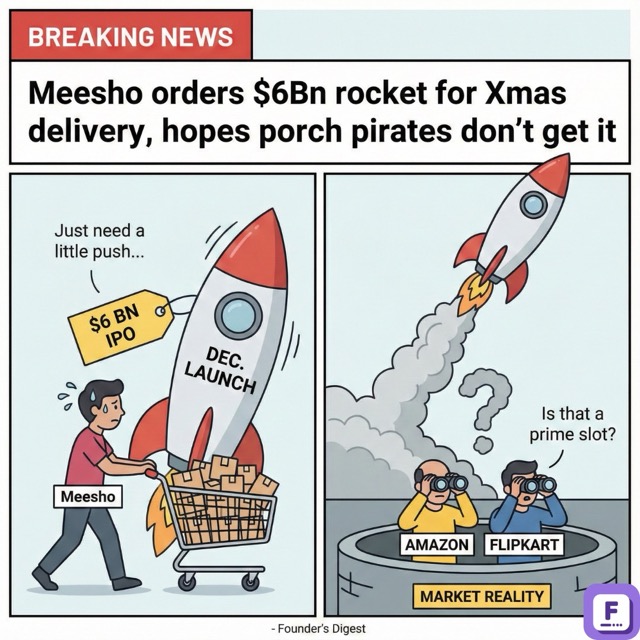
Meesho is targeting a \$6B (₹53,700 Cr) valuation for a December 2024 IPO, aiming to raise ₹4,250 Cr in fresh capital plus an Offer for Sale (OFS). The company completed investor roadshows in mid-November.
The headline loss numbers are misleading. While FY25 net losses ballooned to ₹3,914 Cr, this includes a one-time ₹3,883 Cr tax bill for flipping domicile from Delaware to India. Operationally, the business is cash-flow positive.
This listing is the first litmus test for the “Next Billion Users” thesis at scale. It proves that low Average Order Value (AOV) models can generate free cash flow if logistics costs are brutally optimized. The result: Amazon and Flipkart face immediate pressure to defend their low-end market share against a capitalized incumbent.
WHY IT MATTERS
- For e-commerce incumbents: Logistics subsidies become mandatory. Amazon and Flipkart must burn cash to match Meesho’s distribution costs in Tier 3 towns or cede the sub-₹400 category entirely.
- For D2C brands: Customer Acquisition Costs (CAC) drop 20-30% for mass-market products as Meesho expands its ad platform to monetize its 145M annual transacting users.
- For late-stage investors: The “growth at all costs” era is officially dead. Public markets are rewarding operational leverage (positive free cash flow) over pure GMV expansion.
- For logistics players: Volume surges. Meesho’s 1.3 billion annualized orders create a windfall for 3PL providers (Shadowfax, Delhivery) capable of handling high-volume, low-margin parcels.
BY THE NUMBERS
- Target Valuation: \$6B (Source: Bloomberg, Nov 2024)
- FY24 Revenue: ₹7,615 Cr, up 33% YoY (Source: Company Filings)
- Adjusted Loss: Reduced 97% to ₹53 Cr in FY24 (Source: Company Statement, Oct 2024)
- Free Cash Flow: Positive ₹197 Cr in FY24 (Source: Meesho Annual Report)
- One-time Tax Hit: ₹3,883 Cr in FY25 for domicile flip (Source: Inc42, Nov 2024)
- User Base: 145M Annual Transacting Users (Source: Company Data, FY24)
- Order Volume: 1.3 billion orders (Apr-Dec 2023), up 34% YoY (Source: Angel One Analysis)
- Investor Signal: SoftBank and Prosus are not selling shares in the IPO (Source: DRHP Updates)
COMPETITOR LANDSCAPE
Flipkart remains the dominant player with ~48% market share, but Meesho is the volume leader in the sub-₹500 segment.
Flipkart (Shopsy): The primary threat. Shopsy claims 100M+ users and leverages Flipkart’s existing supply chain. However, Flipkart’s cost structure is built for higher AOV (₹1,500+), making it difficult to compete profitably on ₹300 orders without subsidizing logistics.
Amazon (Bazaar): Lagging. Amazon launched “Bazaar” in 2024 to compete, but its rigorous seller compliance and higher logistics costs act as friction points. Amazon’s market share growth has slowed to 13% vs. Meesho’s 32% user acceleration.
Strategic Divergence:
- Amazon/Flipkart: Monetize via commissions and Prime/Plus subscriptions.
- Meesho: Monetizes via seller advertising and logistics margin. Zero commission attracts the “long tail” of unbranded suppliers (80% of sellers are retail business owners).
INDUSTRY ANALYSIS
Indian e-commerce has bifurcated. Tier 1 cities (Quick Commerce dominance: Blinkit, Zepto) demand speed. Tier 2+ cities (Meesho dominance) demand value.
The shift is structural. FY25 festive season data shows 65% of orders originated from Tier 2/3 cities. The “Bharat” consumer is no longer a theoretical target; they are the primary volume driver.
Public sentiment is cautious but warming. Following the Paytm debacle, investors demand profitability. Meesho’s narrative—”first horizontal e-commerce company to generate positive free cash flow”—is tailored specifically to assuage these fears.
Capital flows reflect this bifurcation. Funding is pouring into Quick Commerce (Zepto’s recent raises) and B2B manufacturing/logistics. General purpose e-commerce funding has dried up, leaving Meesho as the last major liquidity event for the vintage 2015-2020 cohort.
FOR FOUNDERS
- If you are building for Tier 2/3: Unit economics are physics, not suggestions. You must optimize logistics costs to <₹40 per order. If your CAC > ₹100, you cannot survive against Meesho’s ad engine. Action: Audit your logistics stack immediately; unbundle 3PL contracts to pay only for successful deliveries.
- If you are a D2C Brand: Meesho is now a valid distribution channel, not just a clearance bin. Action: List “mass” SKUs on Meesho by Q1 2025 to capture the 145M user base, but keep “premium” SKUs on your own site/Amazon to protect brand perception.
- If you are raising Series A/B: Do not pitch “GMV growth” as your primary metric. Investors will benchmark you against Meesho’s operational efficiency. Action: Highlight “Contribution Margin 3” (CM3) in your deck—show you make money after marketing and logistics.
FOR INVESTORS
- For Late-Stage Portfolios: Meesho’s IPO creates a pricing floor for e-commerce assets. Action: Mark up logistics enablers (e.g., Xpressbees, Shadowfax) in your portfolio. Their volume will compound as Meesho scales.
- For New Deployments: Avoid “me-too” marketplaces. The general merchandise war is over. Action: Look for vertical-specific platforms (e.g., silver jewelry, farm inputs) where Meesho’s horizontal model lacks depth/trust.
- Signal to Watch: Watch the “Take Rate” (Ad revenue / GMV). If Meesho can push this above 5% while keeping sellers happy, the \$6B valuation is cheap. If sellers churn due to high ad costs, the model breaks.
THE COUNTERARGUMENT
The Counterargument: The \$6B valuation is fragile because Meesho lacks customer loyalty. The platform’s users are hyper-price sensitive. Retention rates in the sub-₹500 category are notoriously low; users switch instantly if Shopsy drops prices by ₹10. Furthermore, Meesho’s “zero commission” model relies heavily on ad revenue. In a slowing economy, sellers cut ad budgets first, which would decapitate Meesho’s revenue growth even if GMV remains high.
This view would be correct if: (1) Flipkart aggressively subsidizes Shopsy for 12+ months (burning \$500M+), or (2) Inflation forces logistics providers to hike rates, destroying Meesho’s thin unit economics.
BOTTOM LINE
Meesho’s IPO validates that the Indian mass market is profitable at scale, provided you don’t play by Amazon’s rules. The \$6B listing will trigger a consolidation wave in 2025—smaller vertical marketplaces will be acquired or die as capital concentrates around the winners. The window to build a generic marketplace in India is now closed.
