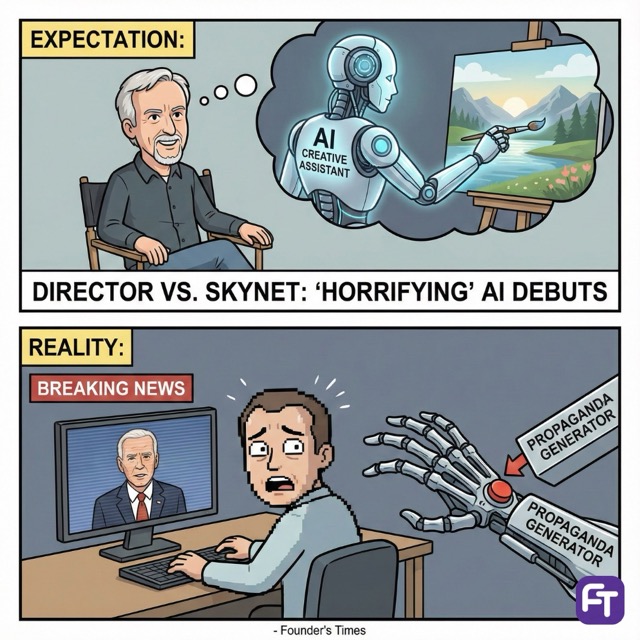
THE SITUATION
James Cameron—arguably cinema’s most pro-technology director—labeled generative AI “horrifying” and an “existential threat” in an October 2025 interview. While serving on the board of Stability AI, Cameron explicitly rejected using AI to replace actors, stating, “I won’t do that.”. He framed the technology not just as a creative tool but as a potential weapon in a global “arms race” that requires massive internal guardrails from Hollywood.
This matters because Cameron is a bellwether for technical adoption, not a Luddite. His rejection of AI actors undermines the “inevitability” narrative pushed by tech vendors. The timing coincides with a legislative crackdown: 45 U.S. states introduced nearly 700 AI-related bills in 2024 alone, and India just proposed mandatory labeling for AI content. The era of unrestricted experimentation is over; the era of strict liability has begun.
WHY IT MATTERS
- For Media Executives: The “Cameron Standard” creates immediate reputational risk for full AI automation. Studios employing AI actors face backlash not just from unions, but from the technical elite who previously championed innovation.
- For AI Vendors: “Fair use” data scraping is a toxic asset. Enterprise buyers will require indemnification against copyright claims within 12 months as “clean data” becomes a procurement non-negotiable.
- For Legal Teams: Compliance budgets expand. Global distribution now requires navigating a patchwork of state laws (California AB 2602) and international mandates (India’s 10% labeling rule).
BY THE NUMBERS
- State Legislation: 45 U.S. states introduced ~700 AI bills in 2024.
- India’s Labeling Mandate: Proposed rules require labels covering 10% of visual content area for AI media.
- Production Efficiency: Indian label Saregama reports AI cut video production time from 10-12 days to 2-3 days.
- Deepfake Surge: Deepfake incidents in India rose 550% since 2019.
- SAG-AFTRA Deal: 2023 contract mandates specific consent and compensation for digital replicas.
CONTEXT
James Cameron joined the board of Stability AI in late 2024, signaling a bridge between Hollywood and Silicon Valley. Stability AI itself has been at the center of the “fair use” storm, facing lawsuits from artists and Getty Images over training data. Cameron’s career is defined by pioneering CGI (Terminator, Avatar), making his “horrified” stance on generative AI a significant deviation from his pro-tech history. He distinguishes between “computer-assisted” (which he uses) and “generative replacement” (which he rejects).
COMPETITOR LANDSCAPE
The market is bifurcating into “Clean AI” and “Wild West AI.”
- The “Clean” Tier: Adobe and Getty Images built models on licensed data. They sell legal safety. Their pricing power increases as regulation tightens.
- The “Open” Tier: Midjourney and Stability AI (despite Cameron’s board seat) face existential legal pressure. Their utility is high, but enterprise adoption is capped by copyright risk.
- The Studio Tier: Disney and Sony are building ring-fenced internal tools. They are not buying off-the-shelf generative models for core IP; they are training proprietary models on their own back catalogs to avoid the “data laundering” problem.
INDUSTRY ANALYSIS
The narrative has shifted from “adapt or die” to “comply or pay.” In 2023, the fear was missing the AI wave. In late 2025, the fear is liability. This is visible in capital allocation: investors are cooling on “wrapper” startups that rely on scraping and pouring money into “provenance” and “attribution” infrastructure.
Public sentiment is hardening. The SAG-AFTRA strike victory in 2023 was the first domino; California’s AB 2602 (signed late 2024) codified the requirement for explicit contract terms regarding AI use. India’s aggressive move to mandate 10% screen-area labeling for AI content signals that major growth markets will not tolerate undetectable fakes. The “black box” era of generative AI content is closing.
FOR FOUNDERS
- If you’re building generative creative tools: Audit your training data immediately. Unlicensed scraping is a fatal flaw for Series B+ fundraising in 2026. Pivot to licensed datasets or “bring your own data” enterprise models.
- If you’re an AI service provider: Build “compliance-as-a-service.” Automated labeling and watermarking that meets Indian and EU standards is a standalone product opportunity right now.
- If you’re in media production: Do not use public generative tools for core IP. Ring-fence your workflow. Use open tools for storyboarding, but closed/proprietary tools for final pixels to protect copyright.
FOR INVESTORS
- For GenAI infrastructure portfolios: The “fair use” defense is collapsing. Short companies that cannot prove data lineage. Their legal liabilities will exceed their ARR.
- For Media/Tech investments: Look for the “Verification Stack.” Watermarking, provenance tracking, and deepfake detection companies (like those integrated with C2PA standards) are the new cybersecurity essential.
- Signal to watch: Adoption of “Clean AI” clauses in enterprise MSAs. If Fortune 500s ban “unverified models,” value flows instantly to Adobe/Getty-style walled gardens.
THE COUNTERARGUMENT
The counterargument: Efficiency incentives are too powerful to regulate away. Saregama cut production time by 80% using AI. In a margin-compressed industry, studios may publicly agree with Cameron while privately deploying AI to slash costs. If the output is indistinguishable and the cost is 90% lower, the market may simply price in the legal risk as a “cost of doing business.” Furthermore, if China or other jurisdictions do not regulate as strictly, Western media companies could face a structural cost disadvantage, forcing regulators to blink.
BOTTOM LINE
James Cameron’s warning marks the end of the “permissionless” phase of Generative AI in media. The winners of the next 18 months will not be the models with the best pixels, but the models with the cleanest paperwork. Compliance is now a product feature.
