THE SITUATION
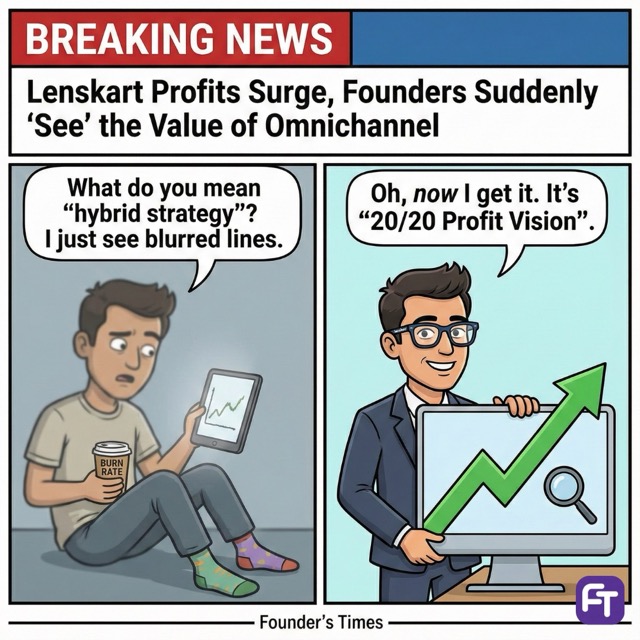
Lenskart posted a consolidated net profit of INR 103.4 Cr in Q2 FY26, a 19.8% year-on-year increase. Revenue climbed 20.8% to INR 2,096.1 Cr.
The critical signal isn’t the top-line growth; it’s the operational leverage. International operations turned profitable for the first time (INR 31 Cr profit vs INR 10 Cr loss previous year), proving the model translates across borders. This effectively ends the “cash burn” criticism that dogged its pre-IPO valuation.
The moat is no longer just distribution; it’s the 69.2% product margin driven by the Bhiwadi manufacturing facility. Lenskart has decoupled from standard retail unit economics.
WHY IT MATTERS
- For D2C founders: The era of “marketing-led” growth is over. Lenskart proves that at scale, backend integration (manufacturing your own inventory) is the only path to public market survival.
- For legacy retail (Titan/Luxottica): The price-to-value ratio has permanently shifted. Competitors outsourcing manufacturing cannot match Lenskart’s pricing without destroying their own gross margins.
- For late-stage investors: Valuation premiums now demand “infrastructure ownership.” Capital will flee asset-light aggregators in favor of vertically integrated operators who control their own supply chain.
BY THE NUMBERS
- Q2 FY26 Revenue: INR 2,096.1 Cr, up 20.8% YoY (Source: Lenskart Q2 FY26 Filing)
- Net Profit: INR 103.4 Cr, up 19.8% YoY (Source: Lenskart Q2 FY26 Filing)
- Gross Product Margin: 69.2%, driven by in-house manufacturing (Source: Shareholder Letter, Nov 2025)
- International Performance: INR 31 Cr profit, swinging from INR 10 Cr loss (Source: Lenskart Q2 FY26 Filing)
- Manufacturing Scale: Bhiwadi facility producing ~3.9M frames in H1 (Source: Shareholder Letter)
- Store Count: 2,500+ globally (Source: Kotak Securities, Nov 2025)
COMPETITOR LANDSCAPE
Titan Eye+ remains the only significant organized rival but trails in volume. While Titan leverages the Tata trust halo for premium pricing, its revenue base (~INR 1,126 Cr annualised pace in late FY25) is now roughly half of Lenskart’s quarterly run rate extrapolated. Titan’s EBIT margins (10-12%) are stable but lack the explosive operating leverage Lenskart is showing from vertical integration.
The Unorganized Sector (local opticians) controls 60-70% of the market but is bleeding share rapidly. They cannot compete with Lenskart’s “2 pairs for medium price” economics, which are subsidized by high manufacturing margins.
Warby Parker (US comparison) serves as the cautionary tale Lenskart avoided. Warby Parker struggled with profitability post-IPO due to high customer acquisition costs (CAC); Lenskart solved this by using physical stores to lower blended CAC and manufacturing to boost LTV (Lifetime Value).
INDUSTRY ANALYSIS
The Indian eyewear market ($15B+) is undergoing a “hard formalization” event. The shift is moving from “eyewear as medical necessity” to “eyewear as fast fashion.”
Current State: Capital is consolidating around winners who own the full stack. The “middle market” of regional optical chains is disappearing—they are either being rolled up (Neso Brands strategy) or squeezed out on price.
Public Sentiment: Institutional investors have shifted from skepticism to fanaticism regarding “India manufacturing.” Post-listing, the narrative on the street is that Lenskart is a “manufacturing company disguised as a retailer.” This sentiment drives the stock’s P/E premium (trading at >100x FY26 earnings).
Capital Flows: Funding for early-stage D2C eyewear brands has effectively dried up. VCs are not funding “Lenskart killers”; they are looking for “Lenskart for [other category]”—companies that can replicate this manufacturing-led retail dominance in shoes, jewelry, or furniture.
FOR FOUNDERS
- If you are building a D2C brand: Your gross margins must exceed 65% within 24 months. You cannot pay platform tax (Amazon/Flipkart ads) and rent without owning your production. Action: Audit your supply chain immediately; if you are just “branding white-label goods,” your ceiling is INR 50 Cr revenue.
- If you are raising Series B/C: Investors will benchmark your “physical footprint strategy.” Pure online scaling is viewed as a CAC trap. Action: Demonstrate a profitable offline unit model (store-level EBITDA > 20%) before pitching.
- If you are competing in a “touch and feel” category: Do not delay offline expansion. Lenskart proved that stores are marketing assets that lower CAC, not just sales channels.
FOR INVESTORS
- For growth-stage portfolios: Audit portfolio companies for “vertical integration potential.” Companies that design and make their own products command a 3x valuation premium over those that just distribute. Action: Push capital toward supply chain ownership, not just ad spend.
- For new investments: Avoid “brand aggregators” who rely on arbitrage. The window for “Thrasio-style” rollups is closed. Look for “Factory-to-Consumer” models where the moat is a proprietary production process that competitors cannot easily clone.
- For Lenskart shareholders: The risk is execution, not demand. Watch the “International Margin” metric closely in Q3 and Q4. If international profits sustain, the stock is cheap even at high multiples; if they dip, the narrative cracks.
THE COUNTERARGUMENT
The counterargument: Lenskart’s valuation ($8B+) prices in perfection that hasn’t happened yet. The P/E ratio is astronomical (>200x).
This valuation assumes the Indian eyewear market will grow at 15%+ CAGR for a decade and that Lenskart will capture all of that growth. If the unorganized sector proves stickier (due to personal relationships with local optometrists), Lenskart’s same-store sales growth (SSSG) could plateau. Furthermore, the 50M capacity expansion in Hyderabad is a massive capex bet; if demand softens, fixed costs could crush the very margins they are currently celebrating.
This view is correct if: (1) SSSG drops below 5%, or (2) Titan launches a discount fighter brand to drag Lenskart into a price war.
BOTTOM LINE
Lenskart has won the category. The only remaining variable is the size of the victory.
Competitors without vertical manufacturing capabilities are now fighting for second place with a permanent mathematical disadvantage. The market belongs to the player who owns the factory, not just the brand.
