THE SITUATION
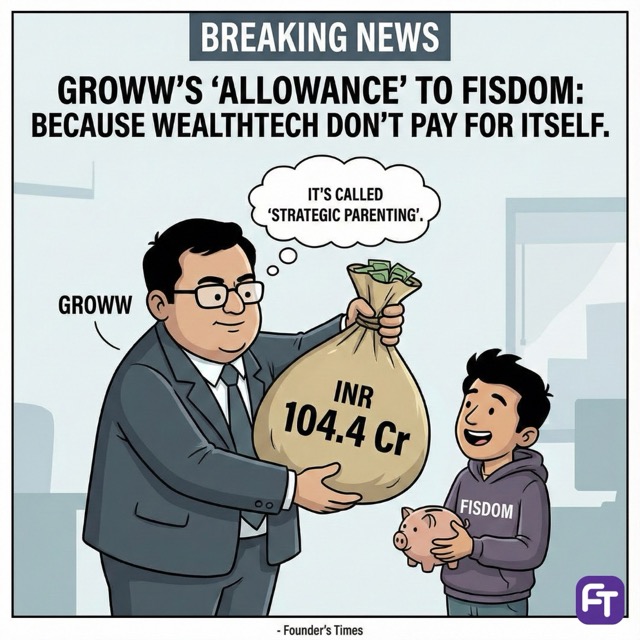
Groww injected INR 104.4 Cr ($12.4M) into its wholly-owned subsidiary Fisdom on November 28, 2025. This capital infusion follows Groww’s $150M all-cash acquisition of the wealthtech platform, which was completed in October 2025.
The capital serves a dual purpose: clearing payouts related to the acquisition and funding immediate working capital requirements. This is not a standard runway extension; it is post-merger balance sheet restructuring.
This move occurs against a backdrop of urgent diversification. With SEBI’s new F&O regulations compressing brokerage revenues—competitor Zerodha reported a ~40% drop in brokerage revenue in June 2025—Groww is aggressively shifting dependence away from trading volume toward stable, advisory-led wealth management fees.
WHY IT MATTERS
- For Groww Shareholders/Pre-IPO Investors: The valuation narrative shifts from “transactional broker” (volatile, regulated) to “wealth platform” (recurring, sticky) ahead of the planned INR 7,000 Cr ($830M) IPO.
- For Niche Wealthtech Founders: Exit liquidity is confirmed, but only for platforms with significant AUM or licenses. Pure “user growth” startups without monetization engines will face consolidation pressure within 12 months.
- For Competitors (Zerodha, Angel One): The battleground has moved. Price wars on brokerage are over; the new war is for “Share of Wallet” via advisory and credit, where Groww is buying capability rather than building it slowly.
BY THE NUMBERS
- Investment Amount: INR 104.4 Cr ($12.4M approx) via rights issue.
- Fisdom Acquisition Price: ~$150M (approx INR 1,250 Cr), all-cash deal signed May 2025.
- Groww FY25 Revenue: INR 3,902 Cr, up 49.6% YoY.
- Groww FY25 Net Profit: INR 1,824 Cr (Turned profitable from INR 805 Cr loss in FY24).
- Fisdom FY24 Revenue: INR 84 Cr, up 28% YoY.
- Fisdom FY24 Loss: INR 57.4 Cr, narrowed from INR 70.5 Cr in FY23.
- Groww Active User Base: 12.6 million active NSE clients (26.3% market share) as of June 2025.
COMPETITOR LANDSCAPE
Zerodha: Remains the profitability benchmark but faces growth headwinds. Brokerage revenue dropped ~40% YoY in mid-2025 due to regulatory curbs. Strategically, Zerodha avoids high-cost acquisitions, preferring to build niche products (Varsity, Rainmatter) organically.
Angel One: Aggressive on customer acquisition with a heavy focus on Tier 2/3 cities. They compete directly with Groww on volume but lag in the “Premium Wealth” segment that Fisdom addresses.
Traditional Banks (HDFC, ICICI): The sleeping giants are waking up. They are reclaiming wealth customers by integrating broking into banking apps. Fisdom’s legacy bank partnerships give Groww a unique backdoor into this channel, potentially allowing it to retain customers who might otherwise migrate back to bank-led platforms.
INDUSTRY ANALYSIS
The Indian wealthtech sector is undergoing a forced structural reset triggered by SEBI.
The Shift: The “Discount Broker” era—characterized by zero fees and reliance on F&O losses—is ending. SEBI’s crackdown on F&O speculation has forced platforms to pivot to “Total Wealth” models (Credit + Advisory + Insurance).
Capital Flows: Investors are fleeing pure-play transactional brokers. Capital is moving toward platforms that own the asset (AUM), not just the transaction. Groww’s move to buy Fisdom is a direct response to this: buying AUM and advisory capability to defend margins.
Public Sentiment: Industry leaders are openly acknowledging the pain. Zerodha’s Nithin Kamath has publicly stated that brokerage revenues are shrinking and diversification is the only survival path. The market consensus is that the next 12 months will see massive consolidation as smaller brokers fail to monetize beyond trading.
FOR FOUNDERS
- If you are building a transactional fintech: Pivot to yield generation immediately. Investors will not fund “transaction volume” stories in 2026. You must show how you capture AUM or lend against it.
- If you are a wealthtech with <$100M AUM: Seek consolidation within 6-9 months. The compliance costs (SEBI) and CAC (Customer Acquisition Cost) are rising faster than your LTV (Lifetime Value). Groww and Angel One are buyers now; they may not be later.
- If you are selling to HNIs: Differentiate via access, not convenience. Groww has solved convenience. The only moat left is access to exclusive assets (Private Credit, PE, Pre-IPO) that mass-market apps cannot easily automate.
FOR INVESTORS
- For Public Market Investors: Watch Groww’s IPO filings for “Advisory Revenue” vs. “Broking Revenue.” If advisory/subscription revenue isn’t growing >50% YoY, the stock will trade at a brokerage multiple (low), not a tech multiple (high).
- For VC Investors in Fintech: The “Super App” thesis is validated but closed. Do not fund new generalist wealth apps. Look for “Vertical Wealth”—platforms serving specific demographics (e.g., NRIs, Senior Citizens) or specific asset classes (e.g., real estate fractionalization) where Groww/Fisdom cannot easily compete.
- Portfolio Action: Push portfolio companies to integrate “Embedded Wealth” features. If your lending startup doesn’t offer investment products, it’s leaking LTV to Groww.
THE COUNTERARGUMENT
The counterargument: Fisdom could be a margin drag that dilutes Groww’s IPO story.
Fisdom is still loss-making (INR 57 Cr loss on INR 84 Cr revenue in FY24). Integrating a high-touch, advisory-led business into a low-touch, tech-first product like Groww is notoriously difficult. If cultural friction slows integration, Groww inherits a burn center without gaining the promised AUM synergy.
Furthermore, if SEBI introduces stricter norms on “Digital Advisory” (e.g., capping commissions on mutual funds further), the entire economic rationale for buying Fisdom—monetizing distribution via fees—collapses. This would be correct if regulatory scrutiny shifts from F&O to Wealth Advisory fees in 2026.
BOTTOM LINE
Groww is effectively buying its way out of the “F&O Trap” before its IPO. This INR 104 Cr injection is the final cleanup before taking a diversified “Financial Services” story to the public markets. The window for single-product brokerage apps is closed; the market now belongs to integrated wealth platforms that can monetize assets, not just activity.
