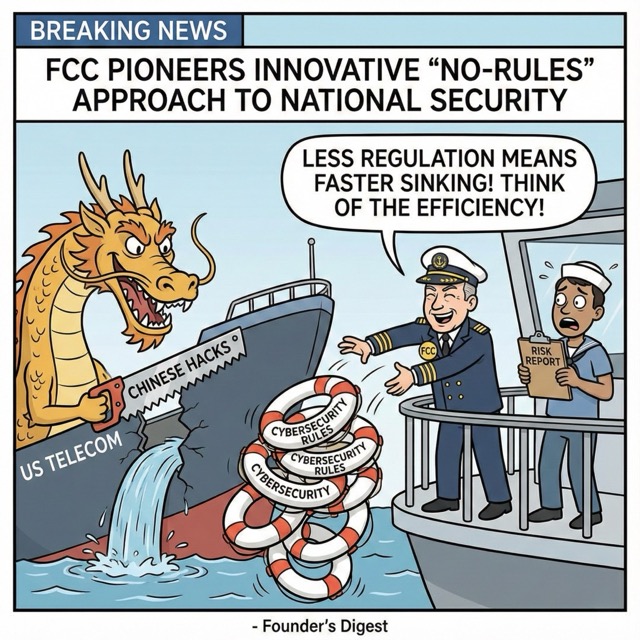
THE SITUATION
The FCC, under Republican Chairman Brendan Carr, voted 2-1 to rescind mandatory cybersecurity reporting rules on November 20, 2025. The decision eliminates the requirement for telecom carriers to secure Border Gateway Protocol (BGP) and report major breaches annually.
This deregulation explicitly prioritizes voluntary collaboration over federal mandates. Carr labeled the previous administration’s rules “unlawful” and “ineffective,” arguing that private sector cooperation yields faster results.
The timing conflicts with operational reality. This vote occurred less than a year after the “Salt Typhoon” hacks, a Chinese state-sponsored campaign that breached AT\&T, Verizon, and Lumen to access wiretap systems.
The immediate impact: US telecom carriers no longer face federal penalties for failing to implement specific BGP security standards. The burden of verifying network integrity now shifts entirely to enterprise customers.
WHY IT MATTERS
- For enterprise customers: Liability transfer is immediate. Without federal mandates acting as a “standard of care,” reliance on carrier-grade security is negligence. CTOs must audit transport encryption within 90 days.
- For cyber insurers: Risk modeling breaks. The removal of the regulatory floor forces underwriters to re-evaluate carrier risk, likely triggering exclusion clauses for “state-sponsored” acts in 2026 renewals.
- For US telecom carriers: Short-term compliance savings (estimated 15% reduction in OpEx) trade against long-term litigation risk. Breach victims can now sue for negligence without carriers hiding behind “FCC compliance.”
BY THE NUMBERS
- Salt Typhoon scope: 9+ major telecom providers breached, including AT\&T and Verizon (Source: The Record, Nov 2025)
- Data compromised: Wiretap systems and metadata for millions of users, including presidential campaign staff (Source: Wikipedia/WaPo, Aug 2024)
- Average breach cost: $4.88M globally in 2024, rising to $6.08M for financial sectors (Source: IBM Cost of a Data Breach Report, 2024)
- Cyber insurance premiums: Decreased 2.6% in Q3 2025 due to soft market conditions (Source: CIAB Survey, Nov 2025)
- Breach lifecycle: Financial firms take 168 days on average to identify breaches (Source: IBM, 2024)
- Regulatory reversal: 2-1 vote split along party lines to rescind the January 2025 declaratory ruling (Source: FCC/Cybersecurity Dive, Nov 2025)
COMPANY CONTEXT
The FCC has oscillated between “Title II” regulation and deregulation for two decades. The previous Chair, Jessica Rosenworcel, attempted to classify BGP security under public safety mandates following repeated breaches. This culminated in the January 2025 declaratory ruling requiring specific hardening measures.
Brendan Carr, now Chairman, has consistently argued that the FCC lacks statutory authority to mandate specific cybersecurity technologies. His philosophy relies on the “C2 ISAC” (a voluntary information-sharing group) rather than federal oversight.
The “Salt Typhoon” hack is the critical backdrop. Identified in mid-2024, this Chinese campaign exploited zero-day vulnerabilities in Cisco and Fortinet routers to access lawful intercept (wiretap) systems. The breach demonstrated that even Tier-1 US carriers lacked visibility into their own compromised infrastructure for months.
COMPETITOR LANDSCAPE
US telecom carriers (AT\&T, Verizon, Lumen) now operate with significantly less regulatory oversight than their global peers. The EU’s NIS2 directive imposes strict liability and reporting timelines (24 hours) for similar critical infrastructure providers.
This divergence creates a security gap between traditional carriers and hyperscalers. Google and Amazon (AWS) run private global backbones that bypass much of the public BGP infrastructure. These networks utilize “Zero Trust” architectures by default, rather than relying on the perimeter security models common in legacy telecom.
The market creates a clear tiered structure:
- Tier 1 (Hyperscalers): Application-layer encryption, private backbones, self-insured security.
- Tier 2 (EU Telcos): Heavily regulated, high compliance costs, government-mandated baseline security.
- Tier 3 (US Telcos): Deregulated, voluntary compliance, high variance in security maturity.
INDUSTRY ANALYSIS
The pendulum has swung from “compliance is the floor” to “market decides security.” This fundamentally alters the procurement landscape for 2026.
Public sentiment among security leaders is grim. Senate Intelligence Committee members and Commissioner Anna Gomez publicly warned that voluntary measures “failed to detect the hacks” previously. On LinkedIn, CISOs at financial institutions are discussing “transport untrustworthiness” as a new baseline assumption for Q1 risk assessments.
Capital flows will follow the risk. With the FCC stepping back, third-party auditing becomes the new regulator.
- Capital IN: Private network assurance platforms (e.g., synthesized testing, BGP monitoring) will see increased demand from enterprise buyers who can no longer trust the pipe.
- Capital OUT: Compliance-focused tools built specifically for FCC reporting requirements lose immediate utility.
The “soft market” for cyber insurance (premiums down 2.6% in Q3 2025) is a lagging indicator. Underwriters act on historical data. The removal of mandates creates a future blind spot. Expect premiums for critical infrastructure clients to decouple from the general market, rising 25-30% as insurers price in the loss of federal oversight.
FOR FOUNDERS
- If you’re building fintech or healthtech apps: Assume the network is compromised. Transport Layer Security (TLS) terminating at the load balancer is insufficient if the underlying pipe is tapped.
- Action: Implement application-layer encryption (ALE) for sensitive payloads before Q2 2026.
- Consequence: If you rely on carrier security, a Salt Typhoon-style breach makes you collateral damage with no recourse.
- If you’re selling enterprise security tools: Pivot your sales pitch immediately.
- Action: Stop selling “compliance.” Start selling “verification.” Pitch your product as the audit mechanism that replaces the FCC.
- Timeframe: Update messaging by January 2026 to align with corporate budget cycles responding to this deregulation.
- If you’re an ISP or regional carrier: The “voluntary” era is a trap.
- Action: Voluntarily adopt the rescinded standards (RPKI, BGP monitoring) and market this aggressively as a differentiator.
- Outcome: You will steal market share from Tier-1 incumbents who cut corners to save OpEx.
FOR INVESTORS
- For exposure to US Telecoms (Verizon, AT\&T): The regulatory discount is gone, but the litigation premium has arrived.
- Thesis impact: Short-term margin improvement (lower compliance costs) masks long-term tail risk.
- Action: Hedge positions against class-action lawsuits stemming from future breaches where “negligence” is easier to prove without safe harbor regulations.
- For Cyber Insurance Insurtech: The modeling opportunity just expanded.
- Thesis: Existing actuarial tables assume a regulatory baseline that no longer exists.
- Action: Invest in MGAs (Managing General Agents) that specialize in “outside-in” scanning of carrier networks. They will price risk more accurately than incumbents relying on questionnaires.
- For Enterprise SaaS: Scrutinize data sovereignty.
- Signal to watch: Enterprise contracts demanding “private backbone routing” or specific exclusion of certain public carriers. This signals a flight to quality that benefits hyperscalers over traditional ISPs.
THE COUNTERARGUMENT
The counterargument: Deregulation may actually improve security speed. Mandates are static; threats are dynamic. The FCC’s rules were based on “standards” that take years to update, while hackers evolve weekly.
Brendan Carr argues that the “C2 ISAC” allows carriers to share threat intel in real-time without fear of regulatory retribution. If carriers redirect the millions spent on compliance reporting into active threat hunting and patching, the net security posture could improve.
This interpretation would be correct if: (1) Carriers voluntarily maintain spending levels despite the removal of the mandate, and (2) The C2 ISAC produces actionable intelligence faster than the government could mandate it. However, historical data from the financial sector suggests that without mandates, security spend reverts to the minimum viable level to prevent catastrophic loss, rather than the optimal level for national security.
BOTTOM LINE
The FCC has effectively privatized national security risks for the telecom sector. The burden of proof for network integrity now falls on the customer, not the carrier.
Enterprises must treat the public internet as a hostile environment, regardless of the ISP. Security strategies relying on “trusted carriers” are obsolete as of November 2025. Encrypt the data, verify the route, and expect no help from the regulator.
Would you like me to draft a memo for your CISO outlining the specific auditing steps needed for your ISP contracts?
