THE SITUATION
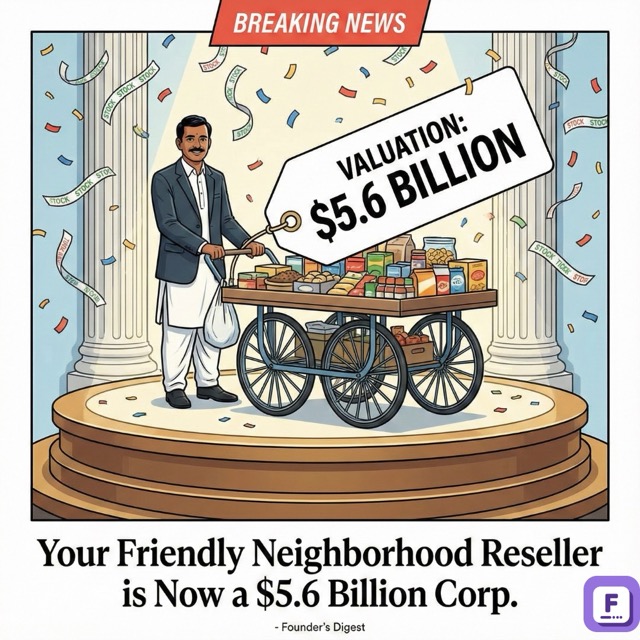
Meesho set its IPO price band at INR 105–111 per share, targeting a $5.6B valuation with the issue opening December 3, 2024. The total issue size is INR 5,421 Cr (~$640M), dominated by a fresh issue of INR 4,250 Cr ($500M+) rather than investor exits.
This structure is a signal, not just a liquidity event. By prioritizing fresh capital over an Offer for Sale (OFS), Meesho is arming itself for a logistics and infrastructure war against Amazon and Flipkart in India’s hinterlands. The valuation represents a stabilization—higher than the $3B markdowns by Fidelity in 2023, but grounded compared to the $8B+ aspirations of 2021.
The timing capitalizes on India’s record IPO run. This is the first major test of the “Next Billion Users” thesis in public markets since Zomato and Paytm, specifically targeting the low-AOV (Average Order Value) value segment.
WHY IT MATTERS
For value-commerce founders: The “growth at all costs” era is officially over. Valuations are now pegged to free cash flow potential, not just GMV. Expect term sheets to include strict contribution margin covenants starting Q1 2025.
For Amazon and Flipkart: Strategic pressure mounts within 12 months. With Meesho capitalized to defend its 32% market share, incumbents must aggressively decouple their value offerings (Amazon Bazaar, Shopsy) or risk losing the Tier 2+ demographic permanently.
For late-stage tech investors: The IPO window is open but discerning. The market accepted Swiggy; it will accept Meesho, but only because the valuation ($5.6B) leaves room for retail upside. Multiples have compressed 30-40% from 2021 highs—this is the new baseline.
BY THE NUMBERS
- IPO Valuation: $5.6B (approx. INR 53,000 Cr) at the upper price band
- Price Band: INR 105 – INR 111 per share
- Fresh Issue Component: INR 4,250 Cr (78% of total issue size)
- H1 FY25 Revenue: INR 5,577 Cr, up 29.4% YoY
- H1 FY25 Loss: INR 700.7 Cr (reduced from INR 2,512.9 Cr in previous period)
- Annual Transacting Users: 199 Million in FY25
- Market Share: 32% of Indian e-commerce volume (vs. Flipkart’s 48%, Amazon’s 13%)
- IPO Dates: Opens Dec 3, Closes Dec 5, 2024.
COMPETITOR LANDSCAPE
Flipkart remains the dominant incumbent with 48% market share, largely defended by its “Shopsy” vertical which mimics Meesho’s low-margin model. Flipkart’s advantage lies in its logistics arm, eKart, which allows for cross-subsidization of delivery costs that Meesho must pay to third parties.
Amazon India (13% market share) has struggled to crack the Tier 2+ market. Its recent launch of “Amazon Bazaar” is a direct response to Meesho’s encroachment. However, Amazon’s core infrastructure is optimized for speed and premium service, making unit economics difficult in the <INR 300 AOV segment where Meesho thrives.
The threat from Quick Commerce (Blinkit, Zepto) is rising but distinct. While they erode urban wallet share, Meesho’s stronghold remains the non-urgent, discovery-based purchase in semi-urban India where 10-minute delivery is structurally unviable.
INDUSTRY ANALYSIS
The Indian e-commerce narrative has shifted from “Total Addressable Market” to “Unit Economics per Pincode.” Public market sentiment in late 2024 favors companies that demonstrate operating leverage. The reduction of Meesho’s losses by ~72% in H1 FY25 aligns with this demand.
Capital flows indicate a consolidation. Late-stage funding for new horizontal marketplaces has dried up. Investors are backing vertical solutions or infrastructure plays. The fact that Meesho is raising INR 4,250 Cr in fresh capital suggests they anticipate a capital-intensive fight for logistics efficiency—the only lever left to improve margins in a zero-commission model.
FOR FOUNDERS
If you are building vertical marketplaces: Unit economics must work at the first transaction. The “burn to acquire” model is dead for Series B+ raises. Action: Audit your contribution margins immediately. If you rely on >3 purchases to recover CAC, pivot to higher AOV categories or organic acquisition channels before Q2 2025.
If you are targeting Tier 2/3 consumers: Logistics costs are your primary adversary. Action: Do not build proprietary logistics until you hit 10k daily orders. Piggyback on the infrastructure aggregators (Delhivery, Xpressbees) who are fighting for volume, using their price war to subsidize your margins.
FOR INVESTORS
For growth-stage portfolios: The valuation benchmark for consumer tech just reset. Meesho trading at ~4-5x revenue (approx.) sets a ceiling. Action: Mark down portfolio companies expecting 10-15x revenue multiples. Push them to extend runway to 24 months, as the IPO exit window will remain selective for high-burn models.
For logistics infrastructure bets: Meesho’s fresh capital will flow directly into third-party logistics providers. Thesis impact: Bullish on 3PL aggregators (Shadowfax, Delhivery) who handle the “unorganized” inventory Meesho moves. Signal to watch: Volume growth in non-metro pincodes in Q1 2025 earnings of listed logistics players.
THE COUNTERARGUMENT
The counterargument: Meesho’s model is structurally unprofitable and the IPO is an exit ramp for trapped capital.
The company relies on low-AOV items (often <INR 350) where logistics costs as a percentage of order value are prohibitively high (20-30%). With a zero-commission model, revenue comes from ads and fulfillment services, which are cyclical. If Quick Commerce players (Blinkit/Zepto) successfully expand into non-grocery categories (fashion, home decor) and extend delivery times to 3-4 hours for lower costs, they could eat Meesho’s urban/semi-urban user base.
This interpretation would be correct if: (1) Meesho’s ad revenue growth stalls below 20% YoY, or (2) Quick Commerce companies launch viable “next-day” delivery verticals for unbranded fashion by mid-2025.
BOTTOM LINE
Meesho’s IPO is a maturity signal for the Indian ecosystem, valuing distribution over pure GMV. The $5.6B valuation is rational, not frothy.
The window for “growth at all costs” is closed. Companies that can monetize the “Next Billion Users” with sustainable unit economics have a 12-18 month runway to dominate before incumbents like Amazon fully re-orient their infrastructure. Bet on efficiency, not just scale.
