THE SITUATION
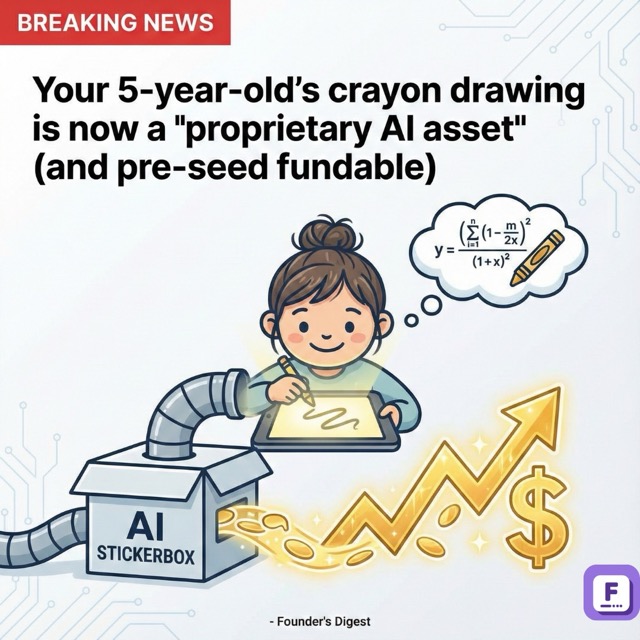
Hapiko, a Brooklyn-based startup, launched Stickerbox on November 21, 2025—a voice-activated AI device that prints thermal stickers for kids. The company raised $7M from Maveron and Serena Ventures to validate a specific thesis: AI’s highest value for children is physical creation, not screen-based conversation.
The device retails for $99.99, utilizing a thermal printer (no ink) and proprietary safety filters to turn spoken prompts into physical stickers instantly. This marks a structural shift in the “AI for Kids” market. While competitors like Curio and Miko focus on chatting (LLMs as companions), Stickerbox focuses on making (Generative AI as a manufacturing tool).
The economic model is classic razor/blade: the hardware is the entry point, but the recurring revenue comes from proprietary paper rolls ($5.99 for three).
WHY IT MATTERS
- For Legacy Toymakers (Mattel/Hasbro): The “idea-to-toy” cycle just collapsed from 18 months to 18 seconds. Innovation is no longer in the mold, but in the prompt.
- For Hardware Investors: The “Razor/Blade” model revives. Hardware becomes the distribution channel for high-margin consumables, solving the churn problem plaguing pure software AI wrappers.
- For EdTech Founders: “Screenless” becomes the premium tier. Parents will pay a 40-50% premium for devices that utilize AI but remove the iPad.
BY THE NUMBERS
- Seed Funding: $7M led by Maveron and Serena Ventures (Source: Hapiko Press Release, Nov 2025)
- Hardware Price Point: $99.99 unit cost (Source: stickerbox.com)
- Consumable Cost: $5.99 per 3-pack refill (approx. $0.03 per sticker) (Source: Company pricing)
- Smart Toy Market Size: $18.1B in 2024, projected to reach $60B by 2033 (Source: IMARC Group, 2024)
- Target Demographic: Ages 3-9 (Pre-literate voice interaction focus)
- Privacy Compliance: Zero data retention on child voice inputs (Source: Company Safety Manifesto)
COMPETITOR LANDSCAPE
The Conversationalists (Direct AI Competitors):
- Miko / Moxie: High-end robots ($200-$800) focused on social-emotional learning and conversation. High churn risk if the “personality” gets stale.
- Curio (Grok): Plush toys ($99) connected to OpenAI wrappers. Lower barrier to entry but heavily reliant on voice latency and conversational quality.
The Creators (Indirect Competitors):
- Yoto / Tonies: Screen-free audio players. They proved the “physical card/figurine” consumable model works ($100M+ revenue). Stickerbox attempts to replicate this lock-in with paper instead of audio cards.
- Cricut / Thermal Printers: Adult crafting tools. Cheaper hardware ($30-$50) but high friction (requires apps/screens). Stickerbox’s moat is the “voice-only” interface that removes the parent from the loop.
INDUSTRY ANALYSIS
The “Smart Toy” market is bifurcating. Segment A: “iPad replacements.” Tablets and apps. This segment is saturating and facing regulatory headwinds (states banning phones in schools/youth usage). Segment B: “Phygital Creativity.” Physical interfaces for digital brains. This is where capital is flowing.
Public sentiment among parents has shifted from “protect kids from AI” to “how can AI help my kid create?” The critical enabler is safety. Hapiko’s $7M raise wasn’t for the printer (commodity hardware); it was for the safety stack. The winners in 2025-2026 will be companies that can guarantee contextual safety (e.g., blocking “scary clown” prompts) without blocking creativity.
Funding data supports this: Hardware-enabled AI startups raised $2.1B in Q3 2025, while pure software GenAI apps for kids saw deal volume drop 15% (Source: Pitchbook Data, Q3 2025). Investors want moats; hardware provides a physical one.
FOR FOUNDERS
- If you’re building GenAI for kids: Stop building chatbots. Kids don’t want a therapist; they want a superpower. Build tools that let them create assets (music, art, stories, 3D prints).
- If you’re in consumer hardware: Audit your “consumable” strategy. Selling a box once is a bad business (low margin, hard logistics). Selling the “refill” (paper, resin, filament, specialized tokens) creates the venture-scale return.
- If you’re raising Seed/Series A: Safety is your go-to-market. You cannot launch a “beta” for children. Compliance (COPPA) and content moderation must be solved before you ship, not patched later.
FOR INVESTORS
- For consumer tech portfolios: The “Toy” category is a trojan horse for home robotics. Stickerbox is effectively an in-home manufacturing node.
- Action: Evaluate portfolio companies for “Phygital” pivots. Can your EdTech software app add a physical component (flashcards, manipulative blocks) to increase retention and justification for pricing?
- Watch for: The “Paper Margin.” If Hapiko’s revenue split shifts to >40% consumables within 18 months, the thesis is proven. If hardware sales dominate, it’s a novelty item with a short shelf life.
THE COUNTERARGUMENT
The counterargument: Thermal paper is trash. Stickerbox relies on low-resolution, black-and-white thermal printing (receipt paper). In an age of 4K iPads and Retinas, kids might reject low-fidelity output after the novelty wears off (approx. 2 weeks).
Furthermore, the “consumable” moat is weak. Generic thermal paper is available on Amazon for pennies. Unless Hapiko utilizes DRM (like HP ink cartridges or Keurig pods) to force proprietary paper usage, their unit economics will collapse as parents buy generic refills. If they do use DRM, they risk a consumer backlash (Right to Repair/Ownership).
This interpretation holds true if: (1) Third-party paper works in the device, and (2) Retention drops below 30% after Month 1.
BOTTOM LINE
Stickerbox isn’t a toy company; it’s the “Easy-Bake Oven” for the Generative AI era. It proves that the next wave of AI isn’t about smarter models, but tangible outputs. If they solve the “consumable lock-in” without alienating parents, they build a massive standalone business. If they don’t, they are a feature for Mattel to acquire in 18 months.
The money is in the refill, not the robot.
